Liquidation Pallets for Sale: Wholesale Inventory for Resellers
Looking for liquidation pallets for sale at competitive wholesale prices? Liquidation pallets can give resellers, small businesses, online sellers, discount retailers, and entrepreneurs access to bulk merchandise at prices below traditional retail.
Liquidation inventory can come from customer returns, overstock, shelf pulls, excess inventory, discontinued merchandise, and other products that retailers and distributors need to move efficiently. Depending on the pallet, buyers may find electronics, home goods, clothing, tools, toys, appliances, and general merchandise.
The key to successful liquidation sourcing is not simply finding the cheapest pallet. It’s finding quality inventory at a cost that makes sense for your resale business.
This guide explains what liquidation pallets are, what types are available, how to evaluate a pallet before purchasing, what to look for in a manifest, how shipping affects your total cost, and how to choose liquidation inventory with greater confidence.
Shop Liquidation Pallets for Sale
, start by identifying the type of merchandise that fits your business.
Common liquidation pallet categories include:
- Electronics liquidation pallets
- Customer return pallets
- Overstock pallets
- Clothing liquidation pallets
- Home and kitchen pallets
- Tools and hardware pallets
- Toys and games
- General merchandise pallets
- Seasonal merchandise
- Mixed-category pallets
Each category has different resale characteristics.
For example, electronics may offer higher individual selling prices but require testing. Clothing can be easier to store but requires attention to sizes, styles, and seasonality. General merchandise provides variety but may require more sorting.
The right pallet is therefore the one that matches your customers, selling channels, storage capacity, and experience.
What Are Liquidation Pallets?
A liquidation pallet is a bulk collection of merchandise assembled for resale after a retailer, manufacturer, distributor, or other business decides the inventory is no longer needed in its normal sales channel.
The merchandise may be sold on wooden pallets, wrapped in stretch film, boxed, or otherwise prepared for wholesale transportation.
Liquidation inventory can originate from several sources.
Customer Returns
Customer returns are products that have previously been sold and subsequently returned.
Returns can happen for many reasons. A customer might change their mind, order the wrong product, receive an item with damaged packaging, or return merchandise that does not meet their expectations.
Because return condition varies, buyers should understand the supplier’s grading and condition descriptions.
Overstock
Overstock is inventory that exceeds a retailer’s or distributor’s current requirements.
These products may be unused and can include seasonal merchandise, excess stock, discontinued products, or inventory that is no longer a priority for the original seller.
Shelf Pulls
Shelf pulls are products removed from retail shelves. Depending on the merchandise and handling process, they may be new, opened, repackaged, or show signs of retail handling.
Salvage
Salvage inventory typically carries greater risk. Products may be damaged, incomplete, defective, or suitable primarily for repair or parts.
Salvage can be appropriate for experienced buyers with repair capabilities, but it is generally not the best starting point for someone new to liquidation.
Types of Liquidation Pallets for Sale
Electronics Liquidation Pallets
Electronics are one of the most popular categories for liquidation buyers.
A pallet may contain:
- Headphones
- Speakers
- Computer accessories
- Chargers and cables
- Smart devices
- Small electronics
- Gaming accessories
- Networking equipment
Electronics can have strong resale demand, but buyers should account for testing, missing accessories, battery condition, compatibility, and potential defects.
Clothing Liquidation Pallets
Clothing pallets can include apparel, footwear, accessories, seasonal products, and fashion merchandise.
They can be attractive for online sellers because individual items are generally easier to store and ship than bulky merchandise.
However, evaluate:
- Sizes
- Styles
- Season
- Condition
- Current fashion demand
- Brand mix
- Packaging
Home and Kitchen Pallets
Home and kitchen liquidation pallets may include cookware, storage products, small appliances, décor, household accessories, and other consumer goods.
These products can appeal to sellers with established home-goods customers.
Tools and Hardware Pallets
Tools and hardware can be another strong category for liquidation resellers.
Potential inventory includes hand tools, power-tool accessories, workshop equipment, hardware, outdoor products, and related merchandise.
As with electronics, condition and completeness should be verified before listing products for resale.
General Merchandise Pallets
General merchandise pallets contain products from multiple categories.
These pallets can be useful for sellers who operate discount stores, flea-market businesses, online stores, or multiple resale channels.
The tradeoff is that mixed pallets can require more time to sort, photograph, price, list, and organize.
How to Choose Liquidation Pallets for Sale
Not every pallet is a good purchase.
Before placing an order, evaluate the following factors.
1. Merchandise Condition
Condition is one of the most important variables.
Look for clear descriptions such as:
- New
- Like new
- Open box
- Customer returns
- Used
- Untested
- Salvage
Don’t assume that all products in a liquidation pallet have the same condition unless the supplier explicitly states that they do.
2. Product Category
Choose products you understand.
If you already sell electronics, an electronics pallet may be easier for you to evaluate than an unfamiliar category.
Your existing knowledge can help you recognize valuable products, identify defects, determine appropriate resale prices, and choose the right sales channels.
3. Manifest
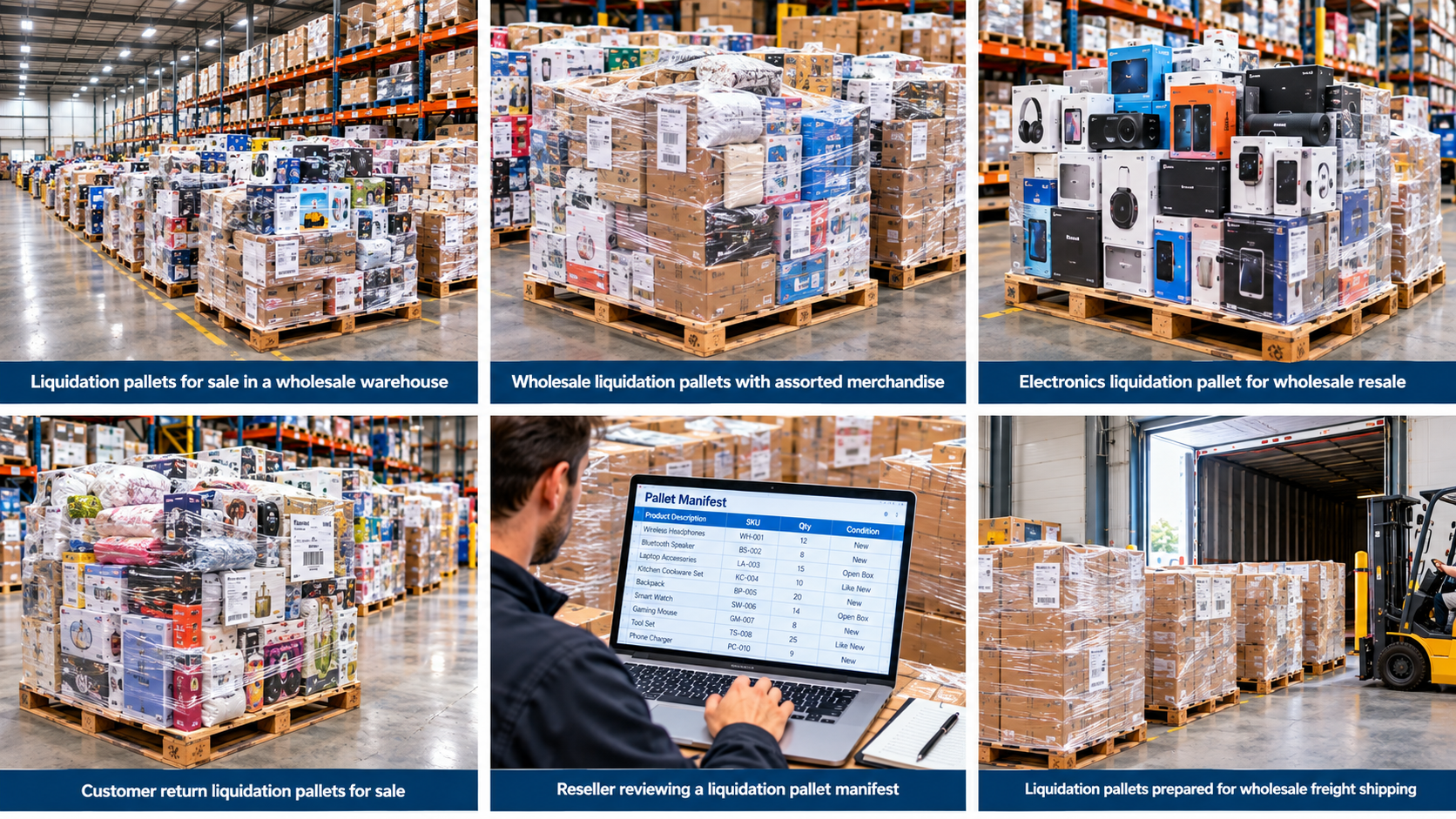
A liquidation pallet manifest can provide valuable information about the inventory.
Depending on the supplier, a manifest may show:
- Product descriptions
- SKUs
- Quantities
- Retail values
- Product categories
- Condition information
A manifest can help you estimate the potential value of a pallet before purchasing.
However, don’t confuse estimated retail value with guaranteed resale revenue.
A product with an original retail price of $100 may not sell for $100 on the secondary market.
4. Photos
Product photos can help you understand the pallet’s condition and composition.
When photos are available, look for signs of:
- Damaged packaging
- Missing components
- Visible wear
- Mixed inventory
- Broken boxes
- Water damage
- Poor storage
Photos should be considered alongside the written product description and condition information.
How Much Do Liquidation Pallets Cost?
There is no standard price for liquidation pallets for sale.
Pricing can vary based on:
- Product category
- Product condition
- Quantity
- Estimated retail value
- Supplier
- Location
- Demand
- Brand mix
- Pallet size
- Shipping requirements
A pallet of new overstock electronics may have a completely different price from a pallet of customer-return general merchandise.
More importantly, the purchase price is only one part of your total cost.
Calculate Your Landed Cost
Use:
Pallet price + freight + fees + taxes + preparation costs = total acquisition cost
Preparation costs may include cleaning, testing, repairs, repackaging, photography, storage, and labor.
Calculating the full cost gives you a more realistic basis for evaluating a liquidation deal.
How to Calculate Potential Resale Profit
A simple profit calculation can help you evaluate an opportunity.
Potential profit = resale revenue − acquisition costs − selling expenses
Suppose a reseller buys a pallet for $700.
Freight and preparation add $300.
The total acquisition cost becomes:
$700 + $300 = $1,000
If the reseller eventually generates $1,600 in sales and spends $300 on marketplace fees, packaging, fulfillment, and other selling expenses:
$1,600 − $1,000 − $300 = $300 estimated profit
This is only an example. Actual profitability will depend on the products received, selling prices, sell-through rate, condition, fees, and other business expenses.
Why Buy Liquidation Pallets?
There are several reasons resellers consider liquidation inventory.
Lower Inventory Acquisition Costs
Liquidation merchandise can be purchased below traditional retail pricing, creating an opportunity for resellers to source inventory at competitive costs.
Bulk Purchasing
Instead of purchasing products individually, buyers can acquire multiple products in one transaction.
Product Variety
Mixed pallets can provide inventory across several categories.
Multiple Resale Channels
Depending on the products, liquidation merchandise can potentially be sold through:
- Online marketplaces
- E-commerce websites
- Discount stores
- Flea markets
- Pop-up shops
- Local resale businesses
- Social commerce
The best sales channel depends on the product category and target customer.
Liquidation Pallets vs. Traditional Wholesale
Traditional wholesale purchasing typically involves buying products directly from manufacturers, distributors, or authorized wholesalers.
Liquidation sourcing is different.
Liquidation inventory may include customer returns, excess inventory, discontinued products, shelf pulls, and other merchandise that is being cleared from an existing supply chain.
This can create opportunities for lower acquisition costs, but it can also introduce more uncertainty around product condition and inventory consistency.
For resellers, the choice depends on their business model.
If you need consistent quantities of identical products, traditional wholesale may be more appropriate.
If you’re comfortable evaluating mixed or variable inventory, liquidation may offer additional sourcing opportunities.
Customer Return Pallets: What Buyers Should Know
Customer return pallets deserve special attention because condition can vary considerably.
A return pallet may contain:
- Unopened products
- Open-box items
- Used merchandise
- Products with damaged packaging
- Products missing accessories
- Untested merchandise
- Damaged items
Before buying customer return pallets, determine how the supplier defines the condition.
If you have the ability to test, repair, clean, and repackage products, customer returns may fit your business better than they would for a beginner.
Overstock Pallets: A Lower-Risk Option?
Overstock pallets may be attractive because the products may not have been previously used by consumers.
However, overstock doesn’t necessarily mean guaranteed resale success.
Inventory can remain unsold because of:
- Low demand
- Seasonality
- Product changes
- Excess supply
- Packaging updates
- Discontinuation
Research current demand before purchasing.
Buying Liquidation Pallets Online
Online sourcing makes it possible to compare liquidation pallets for sale without visiting a physical warehouse.
When buying online, review the complete listing before purchasing.
Check:
Product description: Does it clearly explain what you’re buying?
Condition: Is the merchandise new, returned, used, or untested?
Manifest: Is a product list available?
Photos: Do they represent the actual pallet or generic inventory?
Shipping: What will freight cost?
Policies: What happens if inventory differs from the listing?
Supplier information: Is the business transparent about its inventory and purchasing terms?
A low advertised price isn’t necessarily a good deal if the merchandise has limited resale value or the freight cost is excessive.
Buying Liquidation Pallets Locally
Local liquidation warehouses can provide another sourcing option.
One major advantage may be the ability to inspect inventory before purchasing, depending on the facility’s policies.
Local pickup can also reduce shipping complexity.
Search terms such as “liquidation pallets near me” and “wholesale liquidation near me” can help identify businesses in your area.
If you visit a warehouse, examine the organization of inventory and ask questions about condition, manifests, pallet availability, and purchasing requirements.
Common Mistakes to Avoid
Buying Because the Discount Looks Large
A large discount from retail doesn’t automatically create a profitable resale opportunity.
Focus on realistic resale prices rather than the original retail price.
Ignoring Shipping
A cheap pallet can become expensive once freight is added.
Calculate your landed cost before ordering.
Assuming Every Item Is Sellable
Some liquidation inventory may require testing, repair, cleaning, or disposal.
Build a realistic recovery rate into your calculations.
Buying an Unfamiliar Category
Your knowledge of the merchandise can significantly affect your ability to profitably process and sell it.
Scaling Too Quickly
New resellers can benefit from starting with manageable quantities.
Track your actual sales, expenses, damaged products, and sell-through rate before committing to larger purchases.
How to Build a Liquidation Resale Strategy
Successful liquidation sourcing is more than finding cheap products.
Create a repeatable process.
Step 1: Choose Your Category
Select merchandise that matches your experience and customer base.
Step 2: Establish a Budget
Decide how much you can safely allocate to inventory and freight.
Step 3: Research Resale Prices
Check actual marketplace prices instead of relying only on original retail values.
Step 4: Review the Manifest
Identify the products with the strongest resale potential.
Step 5: Calculate Landed Cost
Include the pallet, freight, fees, taxes, preparation, and storage.
Step 6: Purchase a Manageable Quantity
Start at a scale you can process efficiently.
Step 7: Track Results
Record:
- Purchase cost
- Freight
- Number of sellable items
- Sales revenue
- Marketplace fees
- Repair costs
- Storage
- Profit
Your results can help you identify which categories and suppliers work best for your business.
Are Liquidation Pallets for Sale Worth It?
For the right buyer, liquidation pallets can be a useful inventory-sourcing strategy.
They can provide access to bulk merchandise at potentially attractive acquisition prices and allow resellers to source inventory across many categories.
But liquidation buying comes with risk.
The most important factors are inventory condition, supplier transparency, total cost, resale demand, and your ability to process and sell the merchandise.
A successful buyer doesn’t simply ask, “How cheap is this pallet?”
They ask:
“What will this inventory realistically cost me, and what can I reasonably sell it for?”
That mindset can help turn liquidation sourcing into a more disciplined business strategy.