What Is a Liquidation Store?
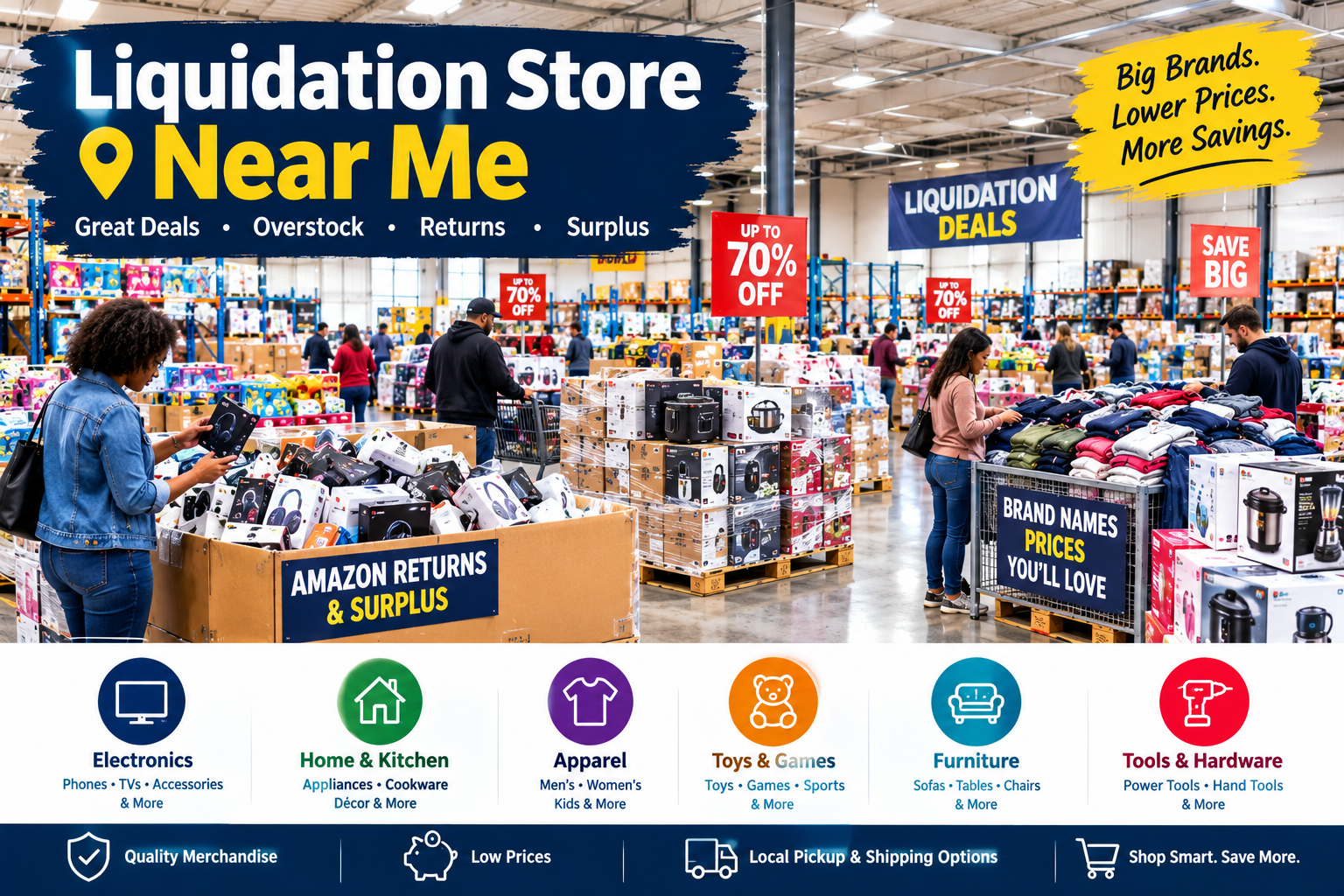
A liquidation store sells merchandise that a retailer, wholesaler, manufacturer, distributor, or other business wants to move quickly.
The inventory can come from several sources, including:
- Customer returns
- Overstock
- Excess inventory
- Store closeouts
- Shelf pulls
- Discontinued products
- Seasonal merchandise
- Open-box products
- Business closures
- Salvage inventory
Some liquidation stores sell products individually to consumers, while others sell merchandise in bulk to resellers and small businesses.
That distinction matters when searching for a liquidation store near me.
A consumer looking for discounted household products may want a local bin or discount store, while a reseller searching for liquidation pallets near me may need a warehouse that sells entire pallets or truckloads.
Liquidation stores can therefore serve two very different audiences: bargain shoppers and entrepreneurs looking for inventory to resell.
How to Find a Liquidation Store Near Me
Searching for “liquidation store near me” is a good starting point, but the first result is not necessarily the best option.
Liquidation businesses can operate under many different names.
Try searching for:
- “liquidation store near me”
- “liquidation warehouse near me”
- “Amazon return store near me”
- “bin store near me”
- “overstock store near me”
- “surplus store near me”
- “liquidation pallets near me”
- “wholesale liquidation near me”
- “discount warehouse near me”
- “return pallets near me”
Different searches can produce completely different businesses.
Some stores specialize in individual discounted products, while others sell bulk inventory to professional resellers.
A useful local search strategy is to compare the business category, inventory type, location, reviews, hours, and purchasing model before making a trip.
Liquidation directories also warn that search results can mix genuine liquidation stores with thrift stores, salvage businesses, estate liquidators, pallet sellers, and ordinary discount retailers.
Liquidation Stores Near Me in Yaoundé
For shoppers and resellers in Yaoundé, Cameroon, local search results currently include several businesses that may be relevant depending on the type of merchandise you’re looking for.
Surplus Merchandise
Sortie Cité Verte is listed as a surplus store in Yaoundé, making it one of the more directly relevant results for someone searching for surplus or liquidation-style merchandise.
Used, Surplus and Household Merchandise
AIMĖ MANAGER, Electroménagers, Equipements Sportifs, Brocante Neufs et d’Occasion, Ecrans Plasmas Toutes Marques is listed in Yaoundé as a thrift store and may be relevant for shoppers looking for appliances, sports equipment, second-hand goods and related merchandise.
Commercial Equipment Liquidation
Liquidation Materiel Restauration & Service Traiteur Professionnel Yaounde is particularly relevant for businesses searching for restaurant, catering or commercial equipment rather than ordinary consumer liquidation merchandise.
Warehouse-Style Shopping
Golden Utensils is listed as a warehouse store at Marché Central and may be useful for shoppers sourcing household and kitchen-related products.
Warehouse Merchandise
KMD STORE is another warehouse-style listing in Yaoundé that may be worth checking when comparing local wholesale or bulk-shopping options.
These businesses are examples of the types of local results that can appear for liquidation, surplus, warehouse and discount searches. They should not automatically be assumed to sell Amazon liquidation pallets, so buyers should contact the business and confirm its current inventory before visiting.
What Can You Buy at a Liquidation Store?
The products available depend heavily on the source of the inventory.
A liquidation store may carry everything from inexpensive household accessories to high-value electronics.
Common categories include:
Electronics
Electronics are among the most searched liquidation categories.
Possible products include:
- Headphones
- Speakers
- Smart devices
- Computer accessories
- Gaming accessories
- Chargers
- Cameras
- Small appliances
- TVs
- Mobile accessories
Electronics can provide strong resale opportunities, but buyers should inspect products carefully.
A returned electronic product may require testing before it can be sold.
Home and Kitchen Products
Liquidation stores frequently carry household merchandise such as:
- Cookware
- Kitchen appliances
- Storage products
- Bedding
- Décor
- Lighting
- Cleaning equipment
- Furniture
- Small household appliances
These products can be particularly attractive to local shoppers because many can be sold without expensive long-distance shipping.
Clothing and Shoes
Local liquidation and surplus stores may also carry:
- Men’s clothing
- Women’s clothing
- Children’s clothing
- Shoes
- Jackets
- Accessories
- Seasonal apparel
For resellers, clothing can be profitable when purchased at the right price, but inventory should be evaluated by brand, size, condition, style and demand.
Toys and Games
Liquidation inventory can include:
- Toys
- Board games
- Children’s products
- Outdoor toys
- Sporting products
- Educational products
Seasonality matters.
A pallet of holiday merchandise may be difficult to sell immediately after the season but valuable when demand returns.
Amazon Return Stores Near Me
One of the most common searches related to liquidation is “Amazon return store near me.”
These stores generally operate independently and purchase liquidation, return or overstock inventory before reselling individual products to consumers.
They are not necessarily official Amazon retail locations.
Some local stores use a bin-store model, where merchandise is placed into large bins and products are sold at predetermined prices.
Other businesses operate more like conventional discount stores.
The inventory can include:
- Amazon returns
- Overstock
- Open-box products
- General merchandise
- Electronics
- Home goods
- Toys
- Clothing
Because inventory is constantly changing, the best products can sell quickly.
If you are visiting a return store, ask:
- Where does the inventory come from?
- Is merchandise tested?
- Are products sold as-is?
- Are returns accepted?
- How often does the store restock?
- Does the store sell individual items or pallets?
- Can resellers purchase larger quantities?
These questions can save you from making assumptions about the merchandise.
Liquidation Pallets Near Me
If you are a reseller, searching for “liquidation pallets near me” may be more useful than searching for a traditional liquidation store.
A liquidation pallet contains multiple products packaged together on a pallet.
A lot may contain:
- Electronics
- Home goods
- Tools
- Apparel
- Toys
- Appliances
- General merchandise
Some pallets are category-specific, while others contain mixed merchandise.
The biggest advantage of buying locally is the potential reduction in transportation complexity.
However, local availability does not automatically make a pallet profitable.
You still need to calculate:
Purchase Price + Transportation + Processing Costs = Landed Cost
Then compare the landed cost with realistic resale revenue.
Liquidation Warehouse vs. Liquidation Store
The terms are sometimes used interchangeably, but they can represent different business models.
Liquidation Store
A traditional liquidation store is generally designed for shoppers.
Products may be displayed individually, allowing customers to inspect and purchase specific items.
Liquidation Warehouse
A liquidation warehouse is more likely to handle bulk inventory.
It may sell:
- Pallets
- Multiple pallets
- Truckloads
- Wholesale lots
- Mixed merchandise
Warehouses can be more suitable for established resellers.
Bin Store
A bin store typically displays large quantities of products in bins.
Customers search through the merchandise themselves.
Prices may be based on a daily or weekly schedule.
The important thing is to determine what the business actually sells, rather than relying solely on the word “liquidation” in its name.
How to Choose the Best Liquidation Store Near You
Finding a nearby store is only the first step.
The better question is:
Which liquidation store gives me the best combination of price, product quality, inventory turnover and convenience?
Consider these factors.
1. Location
A store five minutes away may be more useful than a cheaper supplier several hours away if you need to inspect products regularly.
2. Product Selection
Choose a store that sells categories you understand.
If you resell electronics, an apparel-focused liquidation store may not be useful.
3. Condition
Find out whether inventory is:
- New
- Open box
- Used
- Returned
- Damaged
- Untested
- Salvage
Condition can have a major impact on resale value.
4. Pricing
Compare the actual selling prices rather than assuming a liquidation label means every product is inexpensive.
5. Return Policy
Many liquidation products are sold as-is or under final-sale terms.
Understand the policy before purchasing.
6. Restock Schedule
For bin stores and rapidly changing liquidation retailers, restock timing can be extremely important.
A store may have completely different merchandise from one week to the next.
How to Inspect Liquidation Merchandise
Never assume that discounted merchandise is automatically a bargain.
Before purchasing, inspect:
Packaging
Look for:
- Crushed boxes
- Water damage
- Missing labels
- Open packaging
- Broken seals
Product Condition
Check for:
- Scratches
- Cracks
- Missing parts
- Signs of use
- Cosmetic damage
Functionality
For electronics and appliances, determine whether testing is possible.
Accessories
A product can lose significant resale value if chargers, remotes, cables, manuals or other components are missing.
Quantity
If buying a bulk lot, verify that the actual quantity matches the advertised quantity whenever possible.
How to Buy Liquidation Inventory for Resale
Buying liquidation inventory for personal use is relatively simple.
Buying it as a business requires more planning.
Start with a product category you understand.
Then:
Step 1: Research Demand
Find out whether customers are actually buying the product.
Step 2: Research Resale Prices
Look at current market prices instead of relying on the original retail price.
Step 3: Calculate Your Costs
Include:
- Purchase price
- Transportation
- Packaging
- Marketplace fees
- Repairs
- Cleaning
- Labor
- Storage
Step 4: Set a Maximum Purchase Price
Never allow excitement to determine how much you pay.
Step 5: Estimate Sell-Through Time
A product that sells for a high price but takes six months to sell may be less attractive than a lower-priced product that sells within days.
Is Buying Liquidation Merchandise Worth It?
Liquidation stores can be worthwhile for both consumers and resellers, but the value depends on the individual purchase.
For consumers, the biggest advantage is potentially buying useful merchandise below conventional retail prices.
For resellers, the opportunity is different.
A reseller needs to purchase products at a price low enough to cover:
- Product losses
- Shipping
- Marketplace fees
- Labor
- Storage
- Repairs
- Discounts
- Unsold inventory
Industry guides commonly emphasize checking condition and understanding final-sale policies because liquidation merchandise can contain damaged or incomplete products.
The goal should therefore be profitable inventory, not simply cheap inventory.
How to Find Liquidation Pallets Locally
If your objective is wholesale sourcing, use several search strategies.
Search Google Maps for:
“liquidation pallets near me”
Then try:
“liquidation warehouse near me”
“wholesale liquidation near me”
“surplus warehouse near me”
“Amazon return pallets near me”
“overstock pallets near me”
You can also search local business directories and social-media marketplaces.
Many smaller liquidation businesses do not maintain sophisticated websites and may rely heavily on social media or direct messaging to announce new inventory. Liquidation-store guides specifically recommend checking local social pages because some businesses update restock information there rather than through a frequently updated website.
Local Liquidation Store vs. Online Liquidation Marketplace
You don’t always have to choose between local and online sourcing.
Each model has advantages.
| Local Liquidation Store | Online Liquidation Marketplace |
|---|---|
| Inspect products in person | Larger geographic selection |
| Immediate purchase | More auction opportunities |
| Potentially no freight shipping | More detailed listings may be available |
| Easy local resale | Access to larger lots |
| Convenient for beginners | Better for scalable sourcing |
| Inventory may be limited | Shipping must be calculated |
For a new reseller, local sourcing can be a useful way to learn how liquidation inventory behaves before committing to large pallet purchases.
How to Avoid Liquidation Store Scams
The growing popularity of liquidation has also created opportunities for misleading listings.
Before sending money to an unfamiliar seller, investigate the business.
Warning signs include:
- No verifiable business information
- Unrealistic prices
- Pressure to pay immediately
- No physical location
- No clear inventory information
- Refusal to provide basic purchasing terms
- Requests for unusual payment methods
- Photos that appear copied from unrelated businesses
A legitimate liquidation opportunity should still be evaluated carefully.
Do not assume that a dramatic discount automatically means a good deal.