Walmart Pallet Liquidation: How to Buy Walmart Liquidation Pallets
Walmart pallet liquidation can be an attractive sourcing opportunity for resellers looking to buy returned, excess, refurbished, and other liquidation merchandise in bulk. Depending on the liquidation lot, inventory can include electronics, appliances, furniture, apparel, home goods, sporting goods, toys, tools, and general merchandise.
For buyers, the biggest opportunity is purchasing inventory below traditional retail pricing and reselling individual products through online marketplaces, local stores, social media, flea markets, or other sales channels.
However, Walmart liquidation pallets are not risk-free. Product condition can vary, shipping can significantly affect your costs, and an advertised retail value is not the same as realistic resale revenue.
This guide explains how Walmart pallet liquidation works, where to buy Walmart liquidation pallets, what products you can find, how to evaluate a pallet, how to calculate your maximum purchase price, and how to avoid common liquidation mistakes.
What Is Walmart Pallet Liquidation?
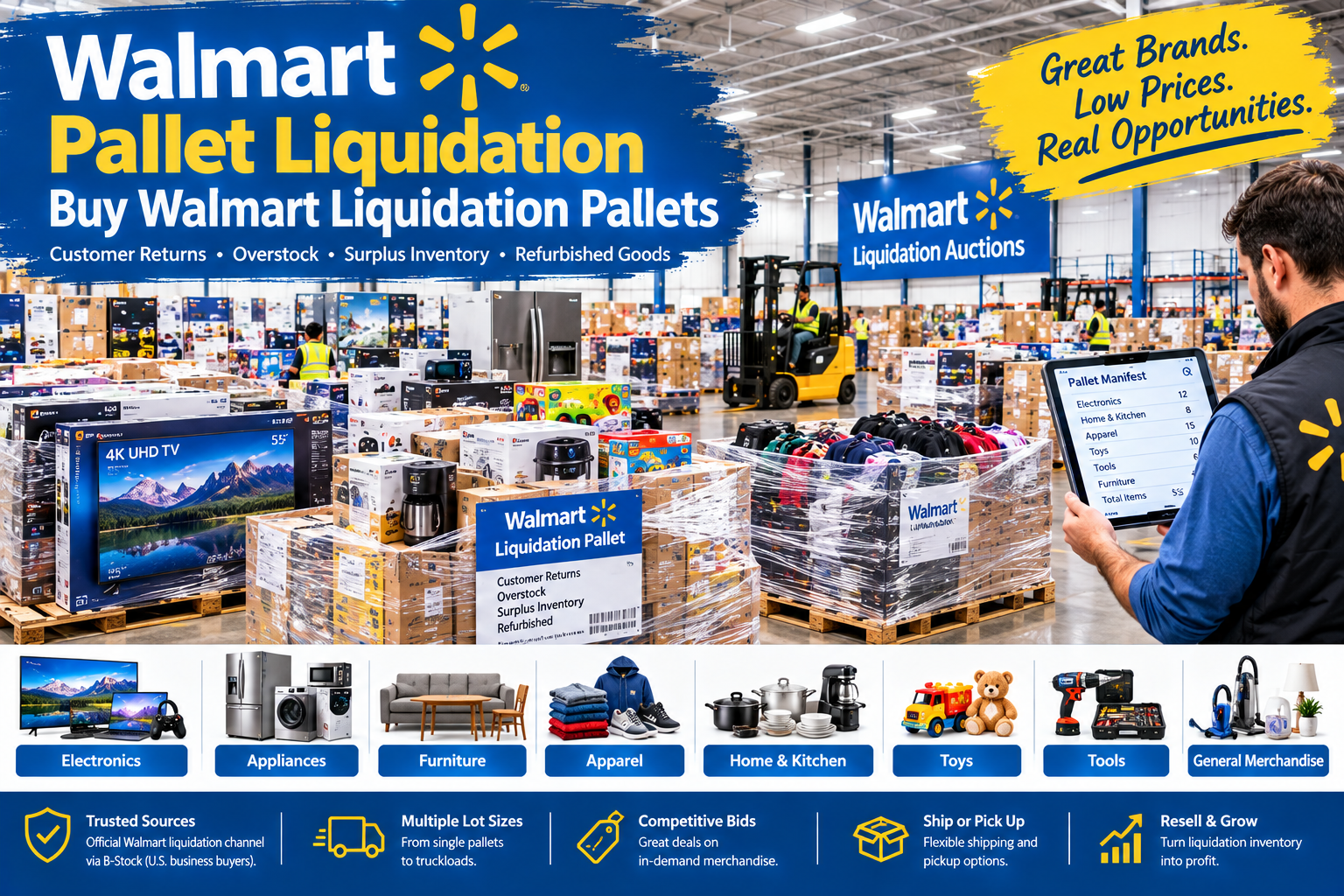
Walmart pallet liquidation is the process of selling Walmart’s excess, returned, refurbished, and other liquidation inventory to approved business buyers.
The official U.S. Walmart Liquidation Auctions marketplace is operated through B-Stock. It describes itself as an official liquidation channel for Walmart.com and Walmart Stores, Inc., offering excess inventory, store returns, and refurbished bulk lots. Lots can range from single pallets to truckloads.
This means Walmart liquidation inventory can provide resellers with access to merchandise that is no longer being sold through Walmart’s standard retail channels.
Inventory can vary significantly from one auction to another.
A pallet might contain:
- Customer returns
- Excess inventory
- Refurbished products
- New-condition merchandise
- Used products
- Mixed-condition merchandise
- Overstock
- Salvage inventory
The exact condition should always be checked on the individual auction listing.
Where to Buy Walmart Liquidation Pallets
For buyers specifically searching for official Walmart liquidation inventory, one important source is the Walmart Liquidation Auctions marketplace on B-Stock.
The marketplace currently lists Walmart liquidation lots in different sizes and categories. Recent listings have included eBikes, small appliances, microwaves, and other merchandise, illustrating how widely the inventory mix can vary.
B-Stock also operates liquidation marketplaces for other major retailers and brands, allowing approved buyers to source returned, excess, and overstock inventory.
There are also independent liquidation companies that advertise Walmart returns or Walmart liquidation merchandise. Buyers should distinguish these third-party suppliers from Walmart’s official liquidation marketplace.
If a company claims to sell “Walmart pallets,” ask where the inventory originated and whether it is actually sourced from Walmart.
Is Walmart Pallet Liquidation Legitimate?
Yes, Walmart has an official liquidation channel.
The official Walmart Liquidation Auctions FAQ states that merchandise sold through the marketplace comes directly from Walmart.com and that orders are picked up from Walmart.com distribution centers.
However, this does not mean every website, social media account, warehouse, or individual advertising “Walmart liquidation pallets” is affiliated with Walmart.
This distinction is extremely important.
Before purchasing from a third-party supplier, verify:
- Business identity
- Physical address
- Inventory source
- Product condition
- Manifest availability
- Payment terms
- Shipping arrangements
- Customer reviews
- Return or dispute procedures
A legitimate Walmart liquidation opportunity should be supported by verifiable information.
Who Can Buy Walmart Liquidation Pallets?
The official U.S. Walmart Liquidation Auctions marketplace is intended for approved business buyers.
According to the current FAQ, buyers must provide a valid reseller’s certificate when applying, and the marketplace is open to buyers located in the United States. There is no fee to apply or to become an approved buyer.
That means a casual consumer shouldn’t assume they can simply create an account and purchase Walmart liquidation inventory without meeting the marketplace’s requirements.
If you intend to buy regularly for resale, make sure your business and resale documentation are in order before applying.
What Can You Find on Walmart Liquidation Pallets?
One of the biggest attractions of Walmart liquidation is the variety of products.
The official Walmart liquidation marketplace says its lots can include products such as TVs, electronics, furniture, bikes, appliances, apparel, and other merchandise.
Electronics
Potential electronics inventory can include:
- Televisions
- Computers
- Tablets
- Audio equipment
- Accessories
- Gaming products
- Smart-home devices
Electronics can have strong resale demand, but testing is essential.
A returned television may work perfectly, require a remote, have cosmetic damage, or be defective.
Never calculate profitability based solely on the original retail price.
Appliances
Appliance liquidation can include:
- Microwaves
- Refrigerators
- Dishwashers
- Washers
- Dryers
- Small appliances
- Kitchen equipment
Large appliances require additional planning because storage, transportation, unloading, and delivery can be expensive.
A pallet that looks profitable on paper may become much less attractive once logistics are included.
Furniture
Furniture liquidation can include:
- Tables
- Chairs
- Desks
- Shelving
- Home furnishings
- Outdoor furniture
- Bedroom furniture
Furniture can be particularly suitable for local resale because avoiding parcel shipping can significantly improve the economics.
Apparel
Apparel liquidation can include:
- Clothing
- Shoes
- Accessories
- Seasonal merchandise
- Bags
When evaluating apparel, consider size distribution, brand demand, seasonality, condition, packaging, and local competition.
Home and General Merchandise
Other categories may include:
- Kitchen products
- Household goods
- Tools
- Toys
- Sporting goods
- Home décor
- Garden products
- Automotive accessories
Mixed pallets can provide product diversity, but they can also make sorting, listing, pricing, and storage more complicated.
Walmart Customer Return Pallets
Customer returns are one of the most interesting categories for liquidation buyers.
A returned product isn’t necessarily defective.
A customer might return an item because:
- They changed their mind
- The product wasn’t what they expected
- The wrong item was ordered
- The packaging was damaged
- The product was opened
- The product had a defect
Consequently, return pallets can contain merchandise in widely different conditions.
The official Walmart liquidation marketplace uses condition categories including New, Like New, Refurbished, Used-Good, Used-Fair, Salvage, and Mixed Condition.
Understanding these categories is essential before calculating a bid.
Walmart Overstock Pallets
Overstock inventory is another major liquidation category.
Overstock products may be:
- Unsold merchandise
- Excess inventory
- Seasonal products
- Discontinued products
- Products removed from regular retail inventory
Overstock can sometimes be less risky than heavily used customer returns because products may be unused.
However, overstock isn’t automatically profitable.
Demand matters.
A product can be brand new and still difficult to sell if customers don’t want it.
Walmart Refurbished Liquidation Inventory
Refurbished products have generally undergone some form of repair or restoration.
The B-Stock condition definitions state that refurbished merchandise has been repaired to full functionality, although signs of wear or use may remain unless otherwise specified.
For resellers, refurbished merchandise can be attractive because functional products may be easier to sell than untested returns.
Still, review the listing carefully to understand exactly what condition is being offered.
Understanding Walmart Liquidation Conditions
Condition should be one of the first things you evaluate.
New
Unsold merchandise with no signs of use.
Like New
Merchandise with minimal signs of handling.
Refurbished
Merchandise repaired to full functionality, potentially showing signs of use.
Used — Good
Used merchandise that is sellable without repairs.
Used — Fair
Merchandise showing heavier use and potentially requiring repair.
Salvage
Inventory requiring significant repairs or intended primarily for parts.
Mixed Condition
A lot containing multiple conditions, potentially including salvage.
These definitions come from B-Stock’s current Walmart marketplace condition information.
Manifested vs. Unmanifested Walmart Pallets
A manifest is one of the most valuable tools available to a liquidation buyer.
A manifest can provide information such as:
- Product description
- Quantity
- SKU
- UPC
- Model
- Retail value
- Category
- Condition
When reviewing a Walmart liquidation manifest, don’t simply add up the retail values.
Instead, research what each product can realistically sell for.
For example:
Retail value: $100
Realistic resale price: $55
Marketplace fees: $8
Shipping: $10
Estimated net: $37
That $100 product may contribute only $37 toward your available margin.
This approach produces a much more realistic valuation.
How Much Do Walmart Liquidation Pallets Cost?
There isn’t one fixed price for Walmart liquidation pallets.
Prices vary according to:
- Product category
- Condition
- Quantity
- Brand
- Retail value
- Demand
- Location
- Current bidding
- Shipping requirements
- Competition
The official Walmart marketplace currently offers lots ranging from individual pallet spaces to truckloads. Recent closed listings shown on the marketplace have included multiple pallets and truckload quantities, demonstrating the range of available lot sizes.
Because auctions are competitive, the final purchase price can change substantially between listings.
How to Calculate Your Walmart Pallet Maximum Bid
One of the most important liquidation skills is knowing when to stop bidding.
Use:
Maximum Purchase Price = Expected Resale Revenue − All Other Costs − Desired Profit
For example:
Expected resale revenue: $6,000
Shipping: $600
Marketplace fees: $900
Repairs and testing: $400
Packaging: $150
Expected losses: $250
Desired profit: $1,500
Maximum purchase price:
$6,000 − $600 − $900 − $400 − $150 − $250 − $1,500 = $2,200
Your maximum bid would therefore be approximately $2,200 under these assumptions.
If competitive bidding pushes the price significantly higher, walk away.
Another pallet will come along.
Landed Cost Matters More Than the Pallet Price
A common mistake is comparing liquidation pallets only by their auction price.
Instead, calculate the complete landed cost.
Landed Cost = Purchase Price + Shipping + Processing + Other Expenses
Depending on your business, other expenses may include:
- Freight
- Fuel
- Labor
- Storage
- Testing
- Cleaning
- Repairs
- Replacement parts
- Packaging
- Selling fees
- Returns
- Disposal
A $1,000 pallet that requires $700 of additional costs isn’t really a $1,000 inventory purchase.
Your real acquisition cost is much higher.
Walmart Liquidation Shipping
Shipping requirements vary by auction.
The current Walmart Liquidation Auctions FAQ identifies both seller-arranged shipping and buyer-arranged shipping locations. For buyer-arranged locations, the buyer is responsible for arranging transportation; for seller-arranged locations, applicable shipping costs are shown on the auction and included in payment.
This is important when comparing two pallets.
Suppose:
Pallet A: $1,200 purchase price + $500 shipping
Pallet B: $1,350 purchase price + $150 shipping
Pallet B costs more at auction but less overall.
Always compare the landed cost, not just the winning bid.
Can You Inspect Walmart Liquidation Pallets?
For the official Walmart Liquidation Auctions marketplace, merchandise cannot be inspected before bidding. The current FAQ says that available information is provided on the auction page and advises buyers to contact the marketplace if listing information is unclear before bidding.
This makes careful listing research especially important.
Review:
- Photos
- Manifest
- Condition
- Quantity
- Location
- Shipping method
- Auction terms
- Estimated retail value
If you need physical inspection before purchase, a local liquidation warehouse may be more suitable than an online auction.
How to Avoid Walmart Pallet Liquidation Scams
Searches for “Walmart pallets” can produce attractive offers on social media and unfamiliar websites.
Be cautious when you see:
- Extremely cheap electronics pallets
- Guaranteed profit claims
- “$10,000 Walmart pallets for $500”
- Urgent payment demands
- Unverified warehouse addresses
- Copied product photographs
- Sellers refusing to provide inventory information
- Unusual payment methods
A legitimate liquidation purchase still involves risk.
Nobody can honestly guarantee that every pallet will produce a particular profit.
How to Resell Walmart Liquidation Inventory
Once you receive your pallet, don’t immediately list everything.
First:
1. Sort the inventory
Separate products by category and condition.
2. Test products
Verify functionality, especially electronics and appliances.
3. Clean merchandise
Presentation can influence selling price.
4. Photograph products
Use clear photographs showing actual condition.
5. Research comparable prices
Don’t automatically copy the original Walmart retail price.
6. Choose the right sales channel
Consider online marketplaces, local sales, flea markets, social commerce, or your own website.
7. Track every sale
Record your actual revenue and expenses.
This data will help you determine whether Walmart liquidation is a profitable sourcing channel for your business.
Where Can You Sell Walmart Liquidation Products?
Potential sales channels include:
Online Marketplaces
Best for products with strong search demand and manageable shipping requirements.
Facebook Marketplace
Useful for local sales, particularly furniture, appliances, and bulky merchandise.
Flea Markets
Can work well for inexpensive general merchandise.
Your Own Website
Useful for developing a long-term brand and customer base.
Local Retail
Some liquidation resellers supply independent shops with discounted merchandise.
Social Media
Short-form product demonstrations and live selling can be effective for certain categories.
The best channel depends on your product type, location, margins, and customer base.
How to Make Money With Walmart Liquidation Pallets
Successful liquidation reselling isn’t simply about buying cheap products.
It’s about buying inventory at a price that leaves room for:
Acquisition + Operations + Profit
A disciplined process looks like this:
Research → Calculate → Bid → Receive → Inspect → Process → List → Sell → Track
Your first few purchases should be treated as learning opportunities.
Track:
- Purchase price
- Shipping
- Product count
- Sellable units
- Damaged units
- Repair costs
- Sales revenue
- Marketplace fees
- Gross profit
- Net profit
- Days to sell
After several purchases, you’ll have your own data showing which Walmart liquidation categories work best for your business.
Walmart Pallets Near Me
If you specifically want Walmart pallets near me, remember that the official Walmart Liquidation Auctions marketplace is an online B2B marketplace rather than a typical walk-in liquidation warehouse.
The current FAQ identifies auction inventory locations including Johnstown, NY; Spartanburg, SC; Bentonville, AR; Indianapolis, IN; Waco, TX; and North Las Vegas, NV, with the individual auction listing providing the relevant physical location.
For buyers outside those areas, shipping may be necessary.
If local pickup is your priority, search for independent liquidation warehouses in your city and ask whether they source Walmart inventory.
But verify the source before assuming a third-party warehouse is directly affiliated with Walmart.
Walmart Pallet Liquidation Buying Checklist
Before bidding or buying, review this checklist:
-
Approved buyer requirements confirmed
-
Reseller documentation ready
-
Auction listing reviewed
-
Manifest reviewed
-
Product condition understood
-
Quantity verified
-
Product demand researched
-
Realistic resale prices calculated
-
Shipping cost calculated
-
Processing costs estimated
-
Selling fees included
-
Potential losses included
-
Maximum bid established
-
Storage space available
-
Sales channel prepared
-
Auction terms reviewed
Never allow the excitement of an auction to replace your calculations.
Common Walmart Liquidation Buying Mistakes
Mistake 1: Focusing on Retail Value
Retail value is useful for comparison, but it isn’t your expected revenue.
Mistake 2: Ignoring Condition
A mixed-condition pallet can contain products requiring significant work.
Mistake 3: Forgetting Shipping
Freight can completely change the economics of a pallet.
Mistake 4: Bidding Emotionally
Set your maximum bid before the auction becomes competitive.
Mistake 5: Buying Categories You Don’t Understand
Start with products you know how to evaluate and sell.
Mistake 6: Underestimating Storage
Pallets can consume considerable space.
Mistake 7: Ignoring Selling Fees
Gross sales aren’t the same as profit.