What Are Amazon Return Pallets?
Amazon return pallets are bulk lots of merchandise that enter the liquidation supply chain after products are returned by customers or otherwise become unsuitable for normal retail inventory.
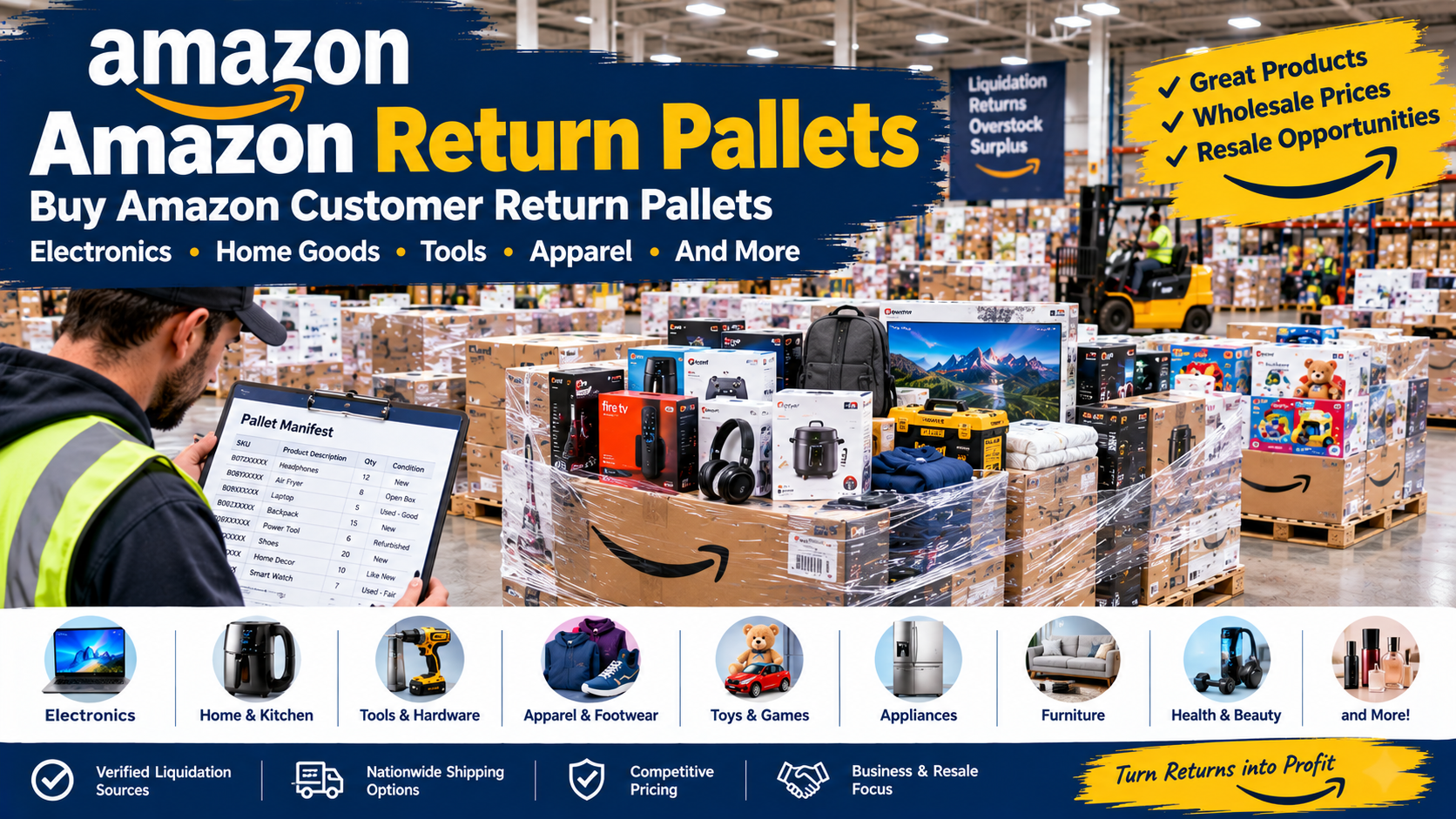
Instead of selling every returned product through Amazon’s standard retail channels, liquidation inventory can be made available to qualified business buyers in larger lots. These lots may contain electronics, home goods, kitchen products, tools, apparel, toys, appliances, accessories, and other consumer merchandise.
For resellers, Amazon return pallets can create an opportunity to acquire inventory in bulk and resell individual products through online marketplaces, local marketplaces, discount stores, ecommerce websites, or other sales channels.
However, buying liquidation inventory is different from purchasing new wholesale merchandise.
A return pallet may contain products in different conditions. Some items may be ready to sell, while others may require testing, cleaning, repackaging, repair, missing accessories, or disposal.
Amazon’s official U.S. liquidation marketplace, operated through B-Stock, lists customer returns, overstock, and warehouse-damaged inventory among its inventory types. It also offers lots in different sizes and product categories.
That makes the central question less about finding the cheapest pallet and more about determining whether the pallet can be purchased at a price that leaves enough room for costs and profit.
How Do Amazon Return Pallets Work?
The basic process is straightforward:
- Find a legitimate liquidation marketplace or supplier.
- Review available Amazon return pallet listings.
- Examine the auction description and available manifest.
- Determine the merchandise category and condition.
- Estimate realistic resale revenue.
- Calculate shipping and other expenses.
- Set your maximum purchase price.
- Bid or purchase according to the marketplace rules.
- Receive and inspect the shipment.
- Sort, test, clean, repair, and photograph the merchandise.
- List products for resale.
- Track actual revenue and profit.
The official U.S. Amazon Liquidation Auctions marketplace currently requires buyers to submit a valid reseller’s certificate, and its U.S. marketplace is limited to buyers in the lower 48 contiguous states. There is no fee to apply or become an approved buyer.
This distinction is important because many websites and social media sellers advertise products as “Amazon return pallets.” The phrase itself does not establish that a seller is affiliated with Amazon.
Always verify the actual source of the inventory.
Where to Buy Amazon Return Pallets
There are several ways to search for Amazon return pallets, but not every source offers the same level of information or reliability.
Amazon Liquidation Auctions
The most important official source for U.S. buyers is Amazon Liquidation Auctions through B-Stock.
Amazon describes this as its official B2B liquidation storefront, giving qualified U.S.-based business buyers access to Amazon liquidation inventory. Available inventory types include overstock, customer returns, and warehouse-damaged merchandise.
The marketplace can include:
- Customer returns
- Overstock
- Warehouse-damaged inventory
- FBA inventory
- Amazon.com inventory
- Sortable products
- Non-sortable products
- AMXL products
- Mixed product categories
Product categories can include home goods, apparel and footwear, media, consumer electronics, groceries, and other merchandise. Lots can be available in different sizes.
Other Liquidation Suppliers
Third-party liquidation companies can also offer Amazon-related inventory.
Before buying, determine:
- Where the inventory came from
- Whether it is actually Amazon inventory
- Whether it contains customer returns
- Whether it is manifested
- What condition the products are in
- Whether the seller offers any claims process
- How shipping is calculated
- Whether the seller has a physical business location
A website using Amazon’s name or logo does not automatically mean it is an official Amazon liquidation source.
Amazon Customer Return Pallets vs. Amazon Overstock Pallets
One of the most important distinctions in liquidation sourcing is the difference between customer returns and overstock.
Customer Return Pallets
Customer return pallets contain merchandise that has previously been sold to a consumer and returned.
Depending on the listing, these products may be:
- Unopened
- Like new
- Open box
- Used
- Damaged
- Defective
- Missing accessories
- Incomplete
- Functional but cosmetically imperfect
Overstock Pallets
Overstock merchandise generally consists of products that were not sold through the normal retail channel and are being liquidated.
Overstock can sometimes be easier to evaluate because the merchandise may have more predictable condition, although packaging can still be damaged.
Amazon’s current FAQ states that inventory on its liquidation marketplace includes overstock and customer returns and instructs buyers to review the specific auction title and description for detailed condition information.
For a beginner, a well-manifested lot with clearly described condition can be easier to evaluate than a highly mixed or unmanifested return pallet.
What Is Inside Amazon Return Pallets?
The contents vary by auction and supplier.
One pallet might contain primarily electronics, while another could contain home goods, tools, apparel, toys, or mixed general merchandise.
Electronics Return Pallets
Electronics can be attractive because individual products may have significant resale value.
Potential products include:
- Headphones
- Speakers
- Computer accessories
- Tablets
- Smart-home devices
- Gaming accessories
- Cables
- Peripherals
- Small electronics
The downside is that electronics often require testing.
A product that looks valuable on a manifest may turn out to have:
- A dead battery
- Missing charger
- Broken screen
- Locked account
- Missing accessories
- Software problems
- Cosmetic damage
Build testing time into your cost calculation.
Home and Kitchen Return Pallets
These pallets can contain:
- Cookware
- Small appliances
- Kitchen accessories
- Storage products
- Home décor
- Cleaning products
- Household merchandise
Home goods can work well for online and local resale because many products are relatively easy to photograph and describe.
Tools and Hardware
Tools are another potentially attractive category.
Examples include:
- Hand tools
- Power-tool accessories
- Hardware
- Workshop products
- Garden equipment
- Automotive accessories
Before listing used tools, test their functionality and clearly disclose condition.
Apparel and Footwear
Amazon return pallets can also include:
- Clothing
- Shoes
- Bags
- Fashion accessories
- Seasonal apparel
The challenge is processing.
Apparel may need to be sorted by:
- Size
- Gender
- Brand
- Style
- Condition
- Season
Toys and General Merchandise
Mixed general merchandise can offer substantial variety.
But variety also creates labor.
A pallet containing 200 different products may potentially generate more individual sales than a pallet containing 20 large products, but it can also require considerably more time to process.
How to Read an Amazon Return Pallet Manifest
A liquidation manifest is one of the most important tools available to a reseller.
Depending on the listing, a manifest may provide information such as:
- Product name
- Quantity
- SKU
- UPC
- Model number
- Product description
- Category
- Estimated retail value
- Condition
- Pallet count
- Weight
Use the manifest to research the actual resale opportunity.
Do not simply look at the total retail value.
For example, a pallet might show an estimated retail value of $10,000.
That does not mean you will receive $10,000 in cash when you resell it.
Your actual revenue may be lower because:
- Products need discounts
- Some products are defective
- Some products are incomplete
- Some products are difficult to sell
- Selling platforms charge fees
- Shipping reduces margins
- Repairs cost money
- Inventory may remain unsold
The manifest is a forecasting tool, not a profit guarantee.
How Much Do Amazon Return Pallets Cost?
There is no universal price for an Amazon return pallet.
The final cost can depend on:
- Number of products
- Product categories
- Condition
- Estimated retail value
- Resale demand
- Brand mix
- Pallet size
- Location
- Shipping
- Auction competition
- Manifest quality
On an auction marketplace, the price can change throughout the bidding period.
Therefore, a better strategy is to calculate your maximum purchase price before bidding.
How to Calculate Your Maximum Purchase Price
Use this formula:
Maximum Purchase Price = Expected Resale Revenue − Shipping − Fees − Repairs − Processing − Expected Losses − Desired Profit
For example:
| Cost / Revenue | Amount |
|---|---|
| Expected resale revenue | $5,000 |
| Shipping | $500 |
| Selling/payment fees | $600 |
| Repairs/testing | $250 |
| Processing/packaging | $150 |
| Expected losses | $200 |
| Desired profit | $1,000 |
| Maximum purchase price | $2,300 |
In this example, paying more than $2,300 would reduce the planned profit below the target.
This is why professional liquidation buyers establish a maximum bid before entering an auction.
Don’t Confuse Retail Value With Resale Value
This is perhaps the biggest mistake new liquidation buyers make.
A manifest showing $20,000 in estimated retail value does not mean you can sell the merchandise for $20,000.
Retail value and resale value are different numbers.
Your realistic resale value depends on:
- Current market prices
- Condition
- Product demand
- Competition
- Seasonality
- Selling channel
- Customer expectations
- Platform fees
- Shipping costs
Instead of saying:
“This pallet has $20,000 retail value, so I’ll pay $5,000.”
A more useful approach is:
“What can I realistically sell these products for after accounting for condition, fees, shipping, defects, discounts, and unsold inventory?”
That number should drive your bid.
Amazon Return Pallet Conditions
Condition can dramatically change the value of a liquidation pallet.
Amazon’s current liquidation FAQ states that merchandise includes overstock and customer returns and directs buyers to the individual auction title and description for detailed condition information.
Possible conditions can include products that are:
- New
- Like new
- Used
- Damaged
- Salvage
- Mixed condition
Never assume that a customer return is equivalent to new inventory.
A returned product could have been opened for five minutes—or used for several months.
Before bidding, ask:
- What condition is listed?
- Is the lot manifested?
- Are accessories included?
- Is the merchandise tested?
- Is the inventory sold as-is?
- Are quantities guaranteed?
- What happens if products are missing?
- What claims process applies?
Can You Inspect Amazon Return Pallets Before Buying?
For the current
, merchandise cannot be physically inspected before bidding. Amazon’s FAQ states that available information is provided on the auction page.
That makes the listing information extremely important.
Review:
- Auction title
- Product description
- Manifest
- Condition
- Quantity
- Location
- Estimated retail value
- Shipping
- Auction terms
If important information is unclear, do not assume the most favorable interpretation.
Shipping Amazon Return Pallets
Shipping can significantly affect liquidation profitability.
Amazon’s current shipping information states that standard shipping is automatically calculated on the live auction page. Buyers cannot arrange their own carrier or pick up standard orders themselves. Standard orders may ship by LTL freight, while some shipments of 150 pounds or less may be sent by UPS parcel.
Standard orders may take up to 28 days after payment to ship. Multiple-pallet orders may also arrive in multiple shipments.
The current FAQ also lists a $135 minimum shipping cost per order on Amazon Liquidation Auctions.
Before buying, make sure you have a plan for receiving freight.
You may need:
- Loading dock
- Forklift
- Pallet jack
- Adequate receiving space
- Labor
- Secure storage
B-Stock’s shipping guidance recommends a loading dock or forklift where possible and notes that unloading or lumper fees, if applicable, are the buyer’s responsibility.
What Happens When Items Are Missing?
Amazon’s liquidation process has an important difference from ordinary retail purchasing.
Amazon explains that inventory can still be sold through Amazon.com while auctions are active. As a result, some inventory may no longer be available when an auction closes and the order is prepared.
When this occurs, Amazon provides an adjusted manifest showing what actually shipped and provides an order adjustment credit for missing merchandise. A shipping adjustment credit may also apply based on the percentage of missing merchandise.
For example, if eight units out of 100 are missing, the shipping page explains that an 8% shipping adjustment credit can be applied.
This makes it important to evaluate the actual shipment rather than assuming every item listed in the original auction will necessarily arrive.
How to Inspect Amazon Return Pallets After Delivery
Once the pallet arrives, create a standardized receiving procedure.
1. Photograph the Shipment
Document the:
- Pallet
- Packaging
- Labels
- Visible damage
- Boxes
- Shipment condition
2. Verify the Shipment
Count the pallets and compare the shipment with the available documentation.
3. Sort by Condition
Create categories such as:
- New
- Open box
- Used
- Needs testing
- Needs repair
- Parts only
- Unsellable
4. Test High-Value Items First
Prioritize products where testing can make a major difference to their resale value.
5. Check Accessories
Look for:
- Chargers
- Batteries
- Cables
- Remotes
- Mounting hardware
- Manuals
- Replacement parts
6. Record Everything
Create an inventory spreadsheet containing:
- SKU
- Product
- Condition
- Purchase cost allocation
- Repair cost
- Expected selling price
- Actual selling price
- Date sold
- Profit
This data becomes extremely valuable when deciding which pallet categories to buy next.
How to Resell Amazon Return Pallets
The best resale channel depends on the product.
Online Marketplaces
Individual products can be listed on ecommerce marketplaces where customers are actively searching for specific products.
This approach works particularly well for recognizable products with established demand.
Local Marketplaces
Local selling can be effective for:
- Furniture
- Appliances
- Tools
- Large electronics
- Home goods
Local pickup can reduce shipping complexity.
Your Own Ecommerce Website
Once you have consistent inventory, an ecommerce website can become a long-term sales channel.
Wholesale Bundles
Some products can be grouped into lots and sold to other resellers.
For example, instead of listing 20 low-value accessories individually, you might create a wholesale bundle.
Discount or Liquidation Stores
A physical store can use return pallets as a recurring inventory source.
The key is to match the merchandise to the appropriate customer.
Are Amazon Return Pallets Worth It?
Amazon return pallets can be worthwhile, but there is no guaranteed profit.
Potential advantages include:
- Bulk inventory
- Potentially discounted acquisition costs
- Product variety
- Individual-item resale opportunities
- Local resale opportunities
- Potential recurring inventory sourcing
Potential disadvantages include:
- Unknown product condition
- Defective merchandise
- Missing accessories
- Freight costs
- Labor
- Repair expenses
- Unsold products
- Capital tied up in inventory
- Changing resale prices
The strongest liquidation buyers do not ask whether Amazon return pallets are always profitable.
They ask whether this particular pallet is profitable at this particular price.
Common Amazon Return Pallet Buying Mistakes
Buying Based Only on Retail Value
High estimated retail value does not guarantee high resale revenue.
Ignoring Freight
A cheap pallet can become expensive after shipping.
Forgetting Processing Costs
Your time has value.
Testing, cleaning, photographing, listing, packaging, and customer service all cost money.
Buying Too Much Inventory
If you cannot process 300 products efficiently, buying a 300-unit pallet may create a storage problem instead of a profit opportunity.
Ignoring Product Demand
A product can have a high retail price but poor resale demand.
Failing to Calculate a Maximum Bid
Auction excitement can cause buyers to pay more than their original business model supports.
Assuming Every Return Is Resellable
Returns can contain defective, incomplete, damaged, or otherwise difficult-to-sell merchandise.
Amazon Return Pallets Near Me
The search term “Amazon return pallets near me” indicates strong local commercial intent.
However, proximity should not be the only factor when evaluating a supplier.
Search variations include:
- Amazon return pallets near me
- Amazon liquidation pallets near me
- Amazon liquidation warehouse near me
- customer return pallets near me
- return pallets near me
- liquidation pallets near me
- wholesale liquidation near me
- Amazon return inventory near me
Then compare suppliers according to:
- Inventory source
- Condition
- Manifest availability
- Price
- Minimum purchase
- Pickup options
- Delivery
- Reputation
- Physical location
- Claim policies
A local supplier may save freight costs, but an online supplier may provide a better manifest or broader inventory selection.
Always compare the total landed cost, not just the pallet price.
Local Pickup vs. Online Amazon Return Pallets
Local liquidation purchases can have an advantage because you may be able to inspect available inventory, save on freight, and collect merchandise quickly.
However, local suppliers vary significantly.
Online liquidation marketplaces can offer greater selection and detailed auction information, but freight costs and delivery requirements must be considered.
A simple comparison is:
| Factor | Local Supplier | Online Marketplace |
|---|---|---|
| Inventory access | Local | Broader |
| Freight | Potentially lower | Can be significant |
| Inspection | May be possible | Depends on marketplace |
| Selection | Depends on supplier | Often broader |
| Convenience | Pickup | Delivered |
| Competition | Local | Online |
| Research | Supplier dependent | Listing/manifest dependent |
The right choice depends on your business model.
Amazon Return Pallet Buying Checklist
Before buying, confirm:
-
The supplier is legitimate
-
Inventory source is identified
-
Customer returns vs. overstock is understood
-
Condition is clearly stated
-
Manifest has been reviewed
-
Product categories fit your business
-
Current resale prices have been researched
-
Realistic resale revenue has been calculated
-
Shipping has been calculated
-
Selling fees have been estimated
-
Repairs have been considered
-
Processing labor has been considered
-
Expected losses have been included
-
Maximum purchase price has been calculated
-
Storage is available
-
Receiving equipment is available
-
Resale channels are ready
-
Sufficient cash flow is available