What Are Amazon Return Pallets for Sale?
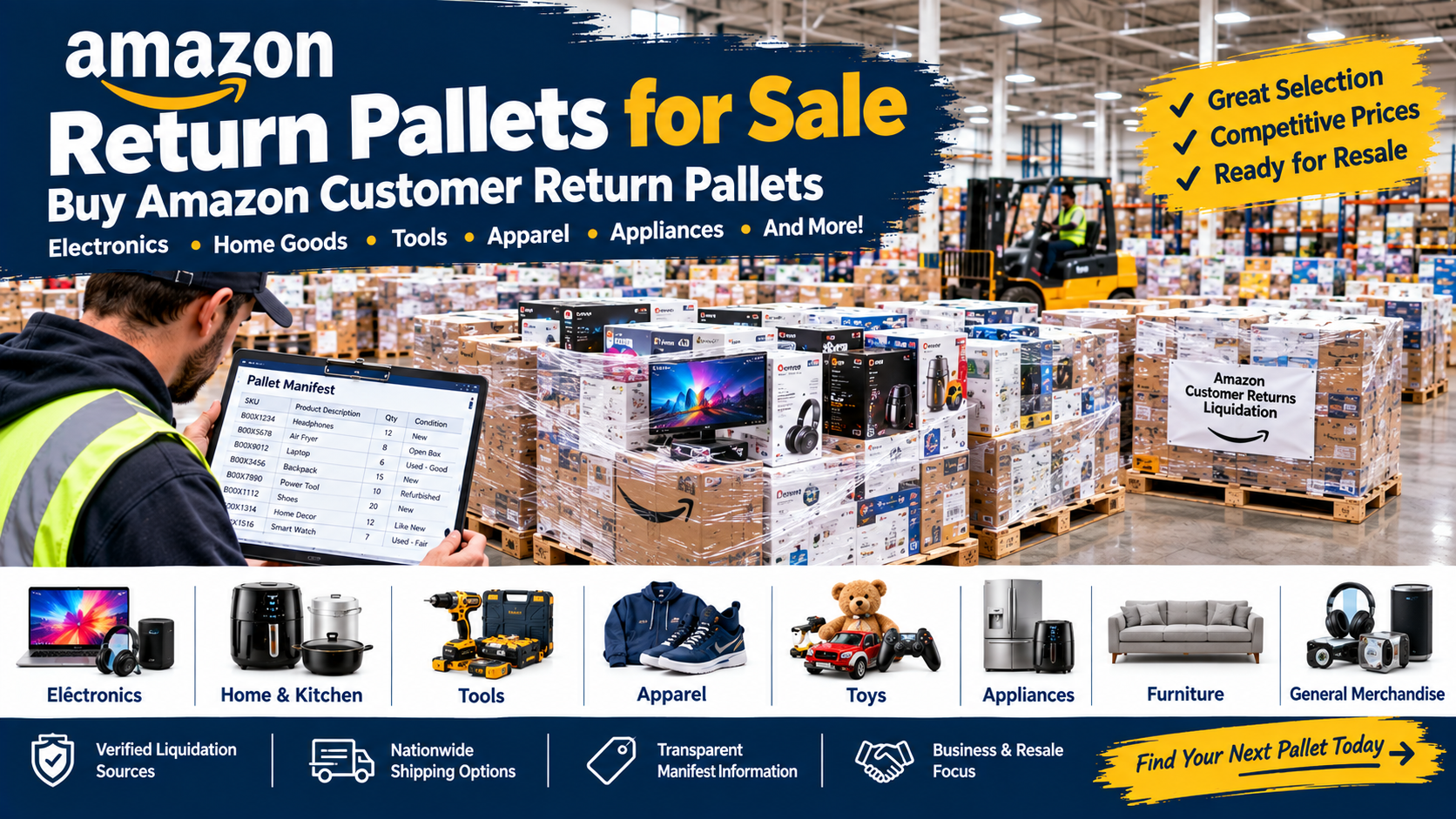
Amazon return pallets are bulk lots of merchandise that have entered the liquidation process after being returned by customers or otherwise removed from normal retail inventory.
When products are returned, they may not simply go back onto a retail shelf. Depending on the merchandise and its condition, products can enter a liquidation channel where business buyers purchase inventory in larger quantities.
A pallet may contain:
- Electronics
- Small appliances
- Home and kitchen products
- Tools
- Apparel
- Shoes
- Toys
- Furniture
- Beauty products
- Accessories
- General merchandise
The condition can vary considerably.
Some merchandise may be new or like new, while other products may be open-box, used, damaged, incomplete, defective, or otherwise unsuitable for immediate resale.
Amazon’s U.S. liquidation terms state that liquidation merchandise can include overstock, customer returns, unsellable and other merchandise, and that merchandise can be in varying physical condition.
That is why Amazon return pallets for sale should be evaluated as business inventory—not as guaranteed bargains.
Where to Find Amazon Return Pallets for Sale
There are several ways to search for Amazon liquidation inventory, but the source matters.
Amazon Liquidation Auctions
For U.S. buyers, one of the most important sources is Amazon Liquidation Auctions through B-Stock.
, providing qualified U.S.-based business buyers access to Amazon liquidation inventory.
The marketplace can include:
- Customer returns
- Overstock
- Warehouse-damaged merchandise
- FBA inventory
- Amazon.com inventory
- Sortable merchandise
- Non-sortable merchandise
- AMXL inventory
Lots can vary in size, allowing buyers to evaluate smaller pallet opportunities as well as larger inventory purchases.
Other Liquidation Marketplaces
Third-party liquidation marketplaces and wholesale suppliers may also advertise Amazon return pallets.
However, always determine exactly what the seller means by “Amazon return pallet.”
Ask:
- Is the inventory actually sourced from Amazon?
- Is it customer return inventory?
- Is it overstock?
- Is it mixed retail inventory?
- Is there a manifest?
- What condition is the merchandise?
- How are shortages handled?
- What are the shipping charges?
- Is there a physical warehouse?
The Amazon name appearing in an advertisement does not by itself prove that the seller is an official Amazon liquidation channel.
Who Can Buy Amazon Return Pallets?
The requirements depend on the marketplace.
For the current U.S. Amazon Liquidation Auctions marketplace, buyers must apply and provide a valid reseller’s certificate. Amazon’s FAQ states that there is no fee to apply or become an approved buyer. The current U.S. marketplace accepts applications from buyers in the lower 48 contiguous United States.
This means that a buyer searching for Amazon return pallets for sale should verify eligibility before spending significant time researching U.S. auction inventory.
International buyers should also avoid assuming that U.S. marketplace requirements apply to other Amazon liquidation marketplaces. Amazon operates separate regional liquidation marketplaces with different requirements.
What Types of Amazon Return Pallets Are for Sale?
The inventory available depends on the individual listing.
Electronics Return Pallets
Electronics are one of the most attractive categories for many resellers because individual products can have meaningful resale values.
Possible merchandise includes:
- Headphones
- Speakers
- Tablets
- Computer accessories
- Gaming accessories
- Smart-home devices
- Cables
- Chargers
- Consumer electronics
However, electronics also carry additional risk.
A returned electronic product may have a damaged screen, missing charger, battery issue, account lock, software problem, or other defect.
Always budget for testing.
Home and Kitchen Pallets
Home and kitchen liquidation inventory can include:
- Cookware
- Small appliances
- Storage products
- Kitchen accessories
- Home décor
- Cleaning products
- Household merchandise
These products can be attractive for online and local resale because many are relatively easy to photograph, describe, store, and ship.
Tools and Hardware Pallets
Tools can be particularly useful for local resellers.
Potential products include:
- Hand tools
- Power-tool accessories
- Hardware
- Workshop equipment
- Automotive accessories
- Garden tools
Used or returned tools should be tested before being advertised as functional.
Apparel and Footwear Pallets
Apparel return pallets can contain:
- Clothing
- Shoes
- Bags
- Fashion accessories
- Seasonal products
The biggest challenge is processing.
Instead of simply unloading a pallet and listing everything, you may need to sort products by size, style, category, season, brand, and condition.
Toys and General Merchandise
Mixed merchandise pallets can provide a broad selection of products.
The advantage is variety.
The disadvantage is labor.
A pallet containing hundreds of different SKUs may require significantly more time to inspect, photograph, list, package, and sell than a pallet containing a smaller number of similar products.
Customer Returns vs. Amazon Overstock Pallets
Not every Amazon liquidation pallet is a customer return.
This distinction matters.
Customer Returns
Customer returns have previously been purchased and returned by consumers.
They can include:
- Unopened products
- Open-box merchandise
- Used products
- Damaged merchandise
- Incomplete products
- Defective merchandise
Overstock
Overstock consists of inventory that is being liquidated because it is excess or otherwise no longer needed for normal retail sales.
Overstock can sometimes provide more predictable inventory conditions, although packaging and merchandise condition can still vary.
If your priority is reducing uncertainty, compare customer-return listings with overstock listings rather than treating them as interchangeable.
How to Read an Amazon Return Pallet Manifest
A manifest can be one of the most important documents when evaluating Amazon return pallets for sale.
A listing may provide information such as:
- Product description
- Quantity
- SKU
- UPC
- Model number
- Category
- Condition
- Estimated retail value
- Pallet quantity
- Weight
Use this information to research realistic resale prices.
Do not simply add up retail prices and assume that total equals your potential revenue.
For example, a manifest could show $15,000 in estimated retail value.
Your actual resale revenue could be much lower because:
- Customers expect discounts
- Some products may be defective
- Some products may be incomplete
- Some items may be difficult to sell
- Marketplace fees reduce revenue
- Repairs cost money
- Products may become obsolete
- Some inventory may remain unsold
The manifest helps you estimate opportunity. It does not guarantee profit.
Are Amazon Return Pallets Sold As-Is?
Buyers should carefully review the specific auction terms.
Amazon’s current terms state that liquidation merchandise is provided “as is” and may include merchandise in varying physical conditions. Accessories such as remote controls, cables, and instructions may or may not be included.
This is why the condition information is critical.
Before purchasing, identify whether the listing is:
- New
- Like new
- Customer returns
- Used
- Damaged
- Salvage
- Mixed condition
Also check whether the merchandise is manifested and what information is provided about product condition.
Never build your financial model around the assumption that every unit will be ready for immediate resale.
Can You Inspect Amazon Return Pallets Before Buying?
For the current U.S. Amazon Liquidation Auctions marketplace, buyers cannot physically inspect merchandise before bidding. The auction listing provides the available information.
This makes your research process especially important.
Before bidding, review:
- Auction title
- Product description
- Manifest
- Condition
- Quantity
- Location
- Estimated retail value
- Shipping
- Terms
- Your expected resale prices
If a listing does not provide enough information for you to estimate risk, consider passing on it.
There will always be another inventory opportunity.
How Much Do Amazon Return Pallets for Sale Cost?
There is no fixed price for an Amazon return pallet.
The final purchase price can depend on:
- Number of units
- Product category
- Product condition
- Estimated retail value
- Current demand
- Brand mix
- Pallet count
- Auction competition
- Shipping
- Manifest quality
Auction prices can change rapidly, so current listings should be evaluated individually rather than relying on an old example price.
The best question is not:
“How cheap is this pallet?”
Instead ask:
“What is the highest price I can pay while still reaching my target profit?”
How to Calculate Your Maximum Purchase Price
Use this formula:
Maximum Purchase Price = Expected Resale Revenue − Shipping − Fees − Repairs − Processing − Expected Losses − Desired Profit
Consider this example:
| Financial Factor | Example |
|---|---|
| Expected resale revenue | $6,000 |
| Shipping | $600 |
| Selling/payment fees | $700 |
| Repairs/testing | $300 |
| Processing/packaging | $200 |
| Expected losses | $300 |
| Desired profit | $1,200 |
| Maximum purchase price | $2,700 |
In this scenario, paying more than $2,700 would reduce the planned profit below the target.
This calculation should be completed before bidding.
It prevents emotional auction bidding from destroying your margins.
Landed Cost Matters More Than Pallet Price
A pallet advertised at $1,500 may not actually cost $1,500.
Your real acquisition cost can include:
Landed Cost = Purchase Price + Shipping + Processing + Other Acquisition Expenses
Other expenses can include:
- Freight
- Liftgate charges
- Unloading
- Storage
- Labor
- Repairs
- Cleaning
- Packaging
- Marketplace fees
For Amazon’s standard U.S. liquidation orders, shipping is automatically calculated on the live auction page, and the current FAQ states that there is a $135 minimum shipping cost per order.
That cost should be incorporated into your maximum bid calculation.
Shipping Amazon Return Pallets
Freight is a major consideration when buying liquidation pallets.
Amazon’s current shipping information states that standard orders may take up to 28 days after payment to ship. Standard orders can ship by LTL freight, while qualifying shipments of 150 pounds or less may ship by UPS parcel. Multiple-pallet orders are not guaranteed to arrive at the same time.
Buyers cannot arrange their own carrier or pick up standard Amazon Liquidation Auctions orders themselves.
You should therefore prepare a suitable receiving location.
Ideally, your location should have:
- Loading dock
- Forklift
- Pallet jack
- Secure storage
- Adequate floor space
- Personnel available to receive freight
B-Stock recommends a loading dock or forklift where possible and states that unloading or lumper fees, if applicable, are the buyer’s responsibility.
What Happens If Items Are Missing?
Inventory shortages are another factor buyers should understand.
Amazon explains that some inventory can remain actively available for sale while auctions are running. Therefore, inventory shown in an auction may not all be available when the order is ultimately prepared.
When a shortage occurs, Amazon provides an adjusted manifest reflecting what actually ships and an adjustment credit for missing merchandise. A corresponding shipping adjustment credit may also apply.
If a substantial amount of inventory cannot be fulfilled, the order may be canceled.
This means buyers should understand the marketplace’s shortage process rather than assuming every item displayed in the original listing will necessarily arrive.
How to Find Amazon Return Pallets Near Me
If you search for Amazon return pallets near me, combine the keyword with your city or region.
Useful searches include:
- Amazon return pallets near me
- Amazon liquidation pallets near me
- Amazon liquidation warehouse near me
- Amazon return pallets for sale near me
- customer return pallets near me
- liquidation pallets near me
- wholesale liquidation near me
- return pallets for sale near me
For local suppliers, compare:
- Inventory source
- Condition
- Manifest availability
- Purchase price
- Minimum order
- Pickup options
- Delivery
- Business reputation
- Physical warehouse
- Claim policy
Do not automatically choose the closest supplier.
A supplier 50 miles farther away may offer substantially better merchandise or pricing.
Local vs. Online Amazon Return Pallets
Both approaches can work.
| Factor | Local Supplier | Online Marketplace |
|---|---|---|
| Convenience | Local pickup | Delivered |
| Freight | Potentially lower | Must calculate |
| Inspection | May be possible | Often restricted |
| Selection | Supplier dependent | Broad |
| Inventory information | Varies | Listing dependent |
| Competition | Local | Online |
| Scaling | Depends on supplier | Potentially broader |
Local inventory can reduce transportation complexity, while online marketplaces can provide access to larger inventories and structured listings.
Compare the landed cost, not just the advertised pallet price.
How to Inspect Amazon Return Pallets After Delivery
Once your inventory arrives, use a repeatable receiving process.
Step 1: Photograph Everything
Take photographs of:
- Pallet condition
- Packaging
- Labels
- Visible damage
- Boxes
- Shipping documentation
Step 2: Count the Inventory
Compare the received shipment with the updated manifest and available documentation.
Step 3: Sort Merchandise
Separate inventory into:
- Ready to sell
- Open box
- Needs testing
- Needs cleaning
- Needs repair
- Parts only
- Unsellable
Step 4: Test High-Value Items
Prioritize electronics, appliances, tools, and other products where testing can materially change resale value.
Step 5: Check Accessories
Look for:
- Chargers
- Batteries
- Cables
- Remotes
- Manuals
- Mounting hardware
- Replacement components
Step 6: Assign Inventory Numbers
Track every sellable product with an internal SKU.
This makes it easier to measure actual profitability.
How to Resell Amazon Return Pallets
Buying the inventory is only half the business.
You also need a resale strategy.
Online Marketplaces
Individual products can be listed online where customers are already searching for specific products.
This works particularly well for recognizable products with established demand.
Local Marketplaces
Local sales can be excellent for:
- Furniture
- Appliances
- Tools
- Large electronics
- Home goods
Local pickup can eliminate some shipping expenses.
Ecommerce Website
Once your business develops consistent inventory, your own ecommerce store can provide another sales channel.
Wholesale Bundles
Some products can be bundled and sold to other resellers.
This can be useful for lower-value merchandise where individual listings would require too much labor.
Physical Discount Stores
A liquidation store can use return pallets as a recurring inventory source, particularly when it has a strong local customer base.
Are Amazon Return Pallets for Sale Worth Buying?
They can be, but profitability depends on the individual lot.
Potential advantages
- Bulk inventory
- Access to diverse products
- Potentially discounted acquisition costs
- Individual-item resale opportunities
- Local resale opportunities
- Potential recurring sourcing
Potential risks
- Variable condition
- Defective products
- Missing accessories
- Freight expenses
- Processing labor
- Repair costs
- Unsold inventory
- Changing resale prices
- Cash tied up in inventory
A good liquidation business does not depend on every pallet being profitable.
Instead, it uses a disciplined buying process to improve the odds that each purchase meets a predetermined financial target.
Common Mistakes When Buying Amazon Return Pallets
1. Buying Based on Retail Value
Retail value is not the same as resale revenue.
2. Ignoring Shipping
Freight can turn an attractive deal into a poor investment.
3. Bidding Emotionally
Auction competition can make buyers exceed their calculated maximum.
4. Ignoring Labor
Your time has a cost.
5. Buying Too Much Inventory
A large pallet is not necessarily better if you cannot process it.
6. Assuming Returns Are Like New
Customer returns can have significant condition variation.
7. Having No Resale Plan
Know where you will sell the products before purchasing the inventory.
8. Ignoring Storage
Pallet inventory takes physical space.
9. Failing to Track Results
Record purchase costs, sales revenue, repairs, fees, and unsold merchandise so you know which categories actually perform.
Amazon Return Pallet Buying Checklist
Before purchasing an Amazon return pallet, confirm:
-
Inventory source is verified
-
Seller or marketplace is legitimate
-
Customer return vs. overstock is understood
-
Condition is reviewed
-
Manifest is available and analyzed
-
Product categories match your business
-
Current resale prices have been researched
-
Expected resale revenue has been estimated
-
Shipping has been calculated
-
Selling fees have been estimated
-
Repair costs have been considered
-
Processing labor has been considered
-
Expected losses have been included
-
Maximum purchase price has been calculated
-
Storage space is available
-
Receiving equipment is available
-
Resale channels are ready
-
Working capital is available