Amazon Liquidation Auctions: How to Buy Amazon Liquidation Pallets & Inventory
If you are looking for a way to buy wholesale merchandise below traditional retail pricing, Amazon Liquidation Auctions can be an attractive source of inventory for resellers, discount retailers, online sellers, flea-market vendors, and liquidation businesses.
Amazon liquidation auctions give qualified business buyers access to inventory that can include overstock, customer returns, warehouse-damaged merchandise, and other liquidation inventory. Through the official Amazon liquidation marketplace operated by B-Stock, buyers can bid on lots ranging from individual pallets to larger quantities.
But buying liquidation inventory successfully requires more than simply finding a low auction price. You need to understand manifests, product condition, shipping costs, potential shortages, resale value, and your maximum profitable bid.
This guide explains how Amazon Liquidation Auctions work, what types of inventory are available, how to evaluate a pallet, and how to build a profitable resale strategy.
What Are Amazon Liquidation Auctions?
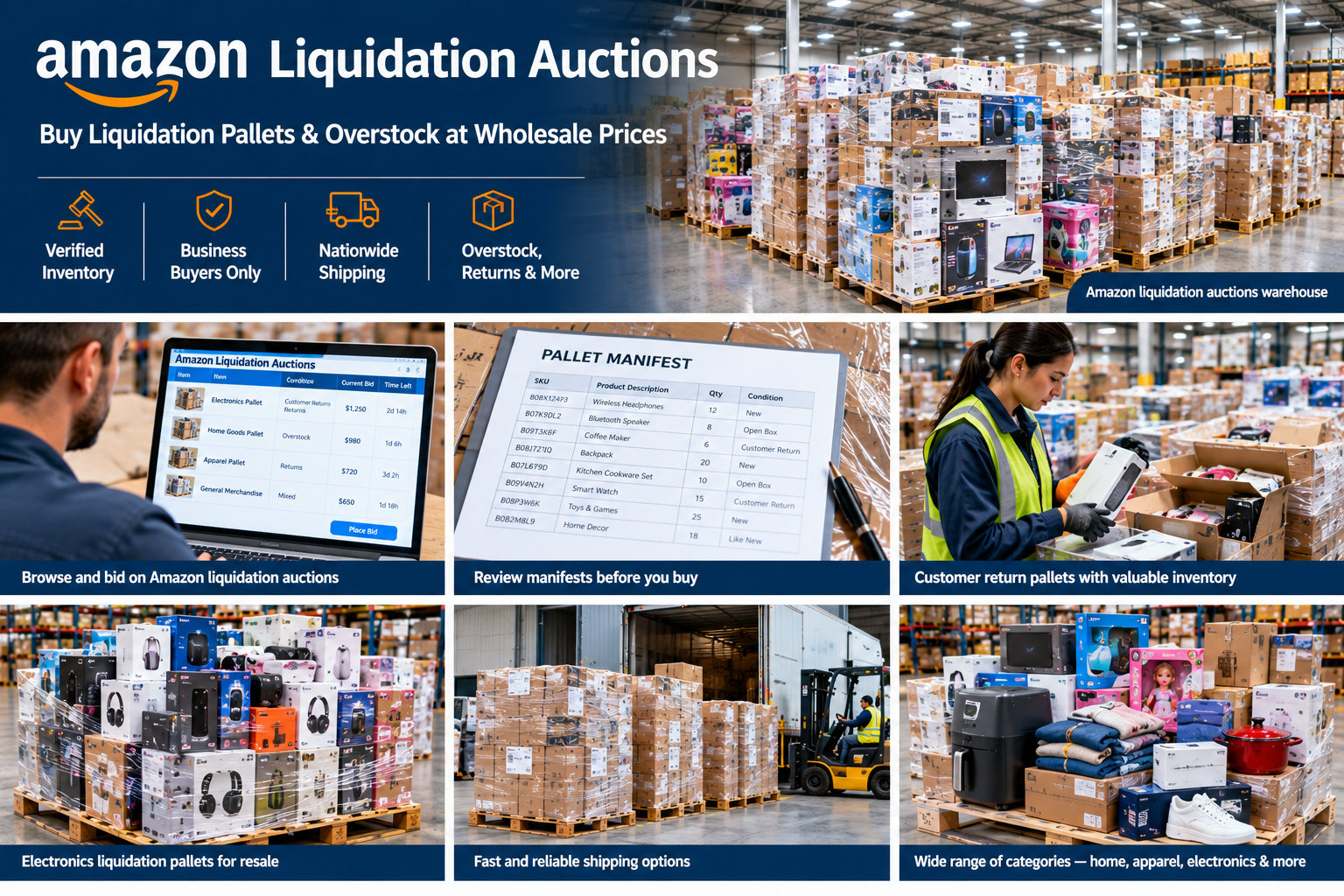
is the official B2B liquidation storefront for Amazon. It gives qualified U.S.-based business buyers access to liquidation inventory through an online auction marketplace. Available inventory can include home goods, apparel and footwear, consumer electronics, media, groceries, and other merchandise categories.
Inventory can come from different sources, including:
- Overstock inventory
- Customer returns
- Warehouse-damaged merchandise
- FBA inventory
- Amazon-owned inventory
- Mixed merchandise lots
Lot sizes can vary considerably, allowing buyers to purchase smaller pallet quantities or larger loads depending on the listing.
Visit Amazon Liquidation Auctions on B-Stock
For resellers, the appeal is straightforward: instead of purchasing individual products at retail prices, buyers can acquire larger quantities of merchandise through wholesale liquidation auctions and then resell individual products for a potential profit.
How Do Amazon Liquidation Auctions Work?
The process is relatively simple, but successful buying requires careful research before placing a bid.
1. Register as a Buyer
First, create an account on the B-Stock platform and complete the required buyer information.
Depending on the marketplace and your business location, registration can require information such as business details, tax identification information, resale documentation, shipping information, and contact details.
For the U.S. Amazon marketplace, buyers should review the current qualification requirements before attempting to bid.
2. Browse Available Auctions
Once approved, buyers can browse available Amazon liquidation auctions.
Listings may contain information such as:
- Product category
- Number of units
- Estimated retail value
- Current bid
- Auction closing time
- Inventory condition
- Location
- Estimated pallet quantity
- Estimated shipment weight
- Manifest information
- Shipping cost
Never evaluate an auction using the current bid alone.
A pallet with a $1,000 winning bid can become significantly more expensive after shipping, taxes, handling, repairs, testing, storage, and other business expenses.
3. Review the Manifest
The manifest is one of the most important parts of a liquidation auction.
A manifest may provide information about the products included in a lot, such as:
- Product description
- Brand
- Quantity
- Retail value
- SKU or product identifier
- Product condition
- Estimated value
Use the manifest to estimate what the inventory could realistically sell for.
Do not automatically assume that the listed retail value equals your potential resale revenue.
A product listed with a $100 retail value may sell for substantially less on the secondary market, particularly if it is used, incomplete, damaged, discontinued, or competing with many other liquidation sellers.
What Types of Amazon Liquidation Inventory Can You Buy?
Amazon liquidation inventory covers a broad range of product categories.
The official Amazon liquidation marketplace currently lists categories including home goods, apparel and footwear, media, consumer electronics, groceries, and more. Inventory types include overstock, customer returns, and warehouse-damaged merchandise.
Amazon Electronics Liquidation
Electronics can be one of the most attractive liquidation categories because individual products may have substantial resale value.
Potential inventory includes:
- Headphones
- Speakers
- Computer accessories
- Smart-home products
- Tablets and devices
- Gaming accessories
- Cables and chargers
- Consumer electronics
However, electronics require careful inspection.
A customer-return electronics pallet may contain products that are unopened, lightly used, defective, incomplete, or missing accessories.
Before bidding heavily on electronics, determine how much testing you can perform and what your return or warranty strategy will be.
Amazon Clothing Liquidation
Clothing liquidation can include:
- Men’s apparel
- Women’s apparel
- Children’s clothing
- Shoes
- Accessories
- Seasonal merchandise
Clothing can be easier to store than bulky products, but profitability depends heavily on brand, size distribution, condition, seasonality, and selling channel.
Amazon Home Goods
Home and household products are another common liquidation category.
Examples include:
- Kitchen products
- Storage products
- Furniture
- Home décor
- Bedding
- Cleaning products
- Small appliances
- Household accessories
These products can work particularly well for local resale because buyers may prefer purchasing household merchandise at discounted prices rather than paying full retail.
General Merchandise
Mixed general-merchandise pallets can contain a wide variety of products.
This creates both opportunity and risk.
The advantage is diversification. You are not relying on one product category.
The disadvantage is that some products may be difficult to sell, require testing, take up significant storage space, or have limited resale demand.
Amazon Return Pallets vs. Overstock Pallets
Understanding inventory condition is critical.
Customer Return Pallets
Customer-return inventory has been previously purchased by consumers and returned.
Returns can happen for many reasons:
- Customer changed their mind
- Wrong size
- Product did not meet expectations
- Product was damaged
- Product was defective
- Product was ordered accidentally
- Product was returned without extensive use
Some returned products may be practically new, while others may require inspection, cleaning, repair, or parts.
This is why return pallets should not be valued as though every item were brand new retail inventory.
Overstock Pallets
Overstock inventory generally represents merchandise that has not sold through normal retail channels or is otherwise excess inventory.
Overstock can be attractive because products may have less wear than customer returns.
However, overstock can still contain products with:
- Limited demand
- Seasonal appeal
- Old packaging
- Discontinued models
- Excess competition
The best approach is to evaluate every lot based on its specific manifest and resale potential.
Are Amazon Liquidation Pallets Worth It?
Amazon liquidation pallets can be worthwhile for experienced resellers, but profitability is not guaranteed.
The key is purchasing inventory at a price that leaves enough room for your complete cost structure.
Consider this simplified example:
Estimated resale revenue: $4,000
Winning bid: $1,500
Shipping: $400
Testing/repair: $250
Packaging and selling expenses: $250
Estimated total cost:
$2,400
Potential gross margin before other business expenses:
$4,000 − $2,400 = $1,600
The numbers above are only an example. Actual profitability depends on the products, condition, selling prices, fees, shipping, labor, and sell-through rate.
The most important principle is this:
Do not calculate profit from retail value alone. Calculate profit from realistic resale value minus total landed cost.
How to Calculate Your Maximum Auction Bid
One of the biggest mistakes new liquidation buyers make is deciding how much to bid emotionally.
Instead, establish a maximum bid before the auction gets competitive.
A basic formula is:
Maximum Bid = Expected Resale Revenue − Shipping − Operating Costs − Desired Profit
For example:
Expected resale revenue: $5,000
Shipping: $500
Repairs/testing: $300
Selling expenses: $400
Desired profit: $1,500
Maximum purchase price:
$5,000 − $500 − $300 − $400 − $1,500 = $2,300
Therefore, you would not want your winning bid to exceed approximately $2,300 under those assumptions.
This method prevents auction excitement from destroying your margins.
Don’t Confuse Retail Value With Resale Value
Liquidation listings often display estimated retail values.
Retail value can help you understand the potential scale of a lot, but it should not be treated as guaranteed revenue.
Suppose a pallet contains products with a listed retail value of $10,000.
You should not automatically assume you can sell the pallet contents for $10,000.
Instead, estimate:
- Current market selling prices
- Product condition
- Number of complete products
- Missing accessories
- Demand
- Competition
- Marketplace fees
- Shipping to your customers
- Returns
- Labor
- Storage
- Expected sell-through rate
Your realistic resale value may be much lower than the original retail value.
Understand Amazon Liquidation Auction Shipping
Shipping is a major part of liquidation purchasing.
For standard Amazon Liquidation Auctions, shipping is calculated through the marketplace, and buyers generally cannot arrange their own carrier or pick up the merchandise themselves. Standard orders can take up to 28 days after payment to ship.
The auction details may show estimated pallet quantities and shipment weight. These figures can change, and orders may sometimes be split into multiple shipments.
That means your calculation should always include the actual shipping charge displayed for the auction.
Why Shipping Matters
Imagine two otherwise identical auctions:
Auction A
- Winning bid: $1,500
- Shipping: $300
- Total: $1,800
Auction B
- Winning bid: $1,500
- Shipping: $900
- Total: $2,400
The winning bid is identical, but the second pallet costs $600 more to acquire.
This is why experienced liquidation buyers evaluate landed cost, not simply auction price.
Amazon Liquidation Auction Inventory Shortages
One unusual feature buyers should understand is that inventory can experience shortages.
According to Amazon’s marketplace information, inventory may still be selling through Amazon.com while an auction is active. As a result, some inventory can become unavailable before the liquidation order is packed.
When this occurs, Amazon provides adjustment credits for missing merchandise and applicable shipping adjustments. A final adjusted manifest reflects what is actually shipped.
This is an important reason to read the marketplace-specific terms before bidding.
Don’t assume that every product shown in an auction will necessarily arrive exactly as originally listed.
B-Stock Blue Amazon Auctions
Some Amazon listings may be designated as B-Stock Blue.
The program is designed around centralized processing and optimized fulfillment. B-Stock states that B-Stock Blue listings can include verified manifests, shipment tracking, fewer shortages, and full order fulfillment.
For buyers who value predictable fulfillment, these listings may deserve special consideration.
Always review the individual auction details because shipping arrangements and terms can vary between listing types.
What Should You Look for Before Buying an Amazon Liquidation Pallet?
Before placing a bid, work through a checklist.
1. Product Category
Buy products you understand.
If you already sell electronics, an electronics pallet may be easier for you to evaluate than an unfamiliar category.
2. Product Condition
Determine whether the inventory is:
- Overstock
- Customer returns
- Warehouse damaged
- Mixed condition
Condition has a direct impact on expected resale value.
3. Manifest Quality
A detailed manifest gives you more information for calculating potential revenue.
Avoid making aggressive bids based on vague product descriptions alone.
4. Current Market Prices
Search for individual products and compare actual selling prices.
Look at competing listings, completed sales where available, and current market demand.
5. Shipping
Add shipping to the purchase price before determining your maximum bid.
6. Storage Requirements
A pallet of small electronics may require significantly less space than a pallet containing furniture or bulky home goods.
Storage costs can quickly reduce margins.
7. Labor
Consider the time required to:
- Unload
- Sort
- Test
- Clean
- Repair
- Photograph
- List
- Package
- Ship
- Handle customer service
Your time is a business cost.
Where Can You Resell Amazon Liquidation Products?
Once you purchase liquidation inventory, the next challenge is selling it.
Popular channels can include:
Online Marketplaces
Individual products can potentially be sold through established ecommerce marketplaces.
This approach works well when products are easy to identify, ship, photograph, and price.
Your Own Ecommerce Store
A dedicated store gives you greater control over branding, pricing, customer relationships, and promotions.
Local Marketplaces
Local selling can be useful for:
- Furniture
- Appliances
- Home goods
- Large merchandise
- Bulky products
Avoiding outbound shipping can significantly improve the economics of oversized products.
Flea Markets and Discount Stores
Liquidation inventory can also be sold through physical retail environments.
This can be especially effective when your inventory consists of inexpensive, fast-moving merchandise.
Wholesale Resale
Some buyers purchase liquidation inventory and then divide larger lots into smaller wholesale bundles for other resellers.
This can reduce the amount of individual retail listing work required.
How to Make Money With Amazon Liquidation Pallets
Successful liquidation reselling is usually less about finding one incredible pallet and more about building a repeatable system.
Buy Within Your Niche
Specialization helps you become better at evaluating inventory.
If you repeatedly purchase electronics, for example, you can learn:
- Which brands sell quickly
- Which models are obsolete
- Which accessories are valuable
- Which products frequently fail
- Which items are easy to test
- Which marketplaces provide the best margins
Track Every Purchase
Maintain records of:
- Auction price
- Shipping
- Taxes
- Repairs
- Labor
- Packaging
- Selling fees
- Revenue
- Unsold inventory
This lets you determine your actual return on investment.
Focus on Sell-Through Rate
A product that produces a large theoretical profit but takes a year to sell may be less attractive than a product with a smaller margin that sells within days.
Cash flow matters.
Learn to Bundle Slow-Moving Products
If individual items are difficult to sell, consider creating bundles.
For example:
- Kitchen accessory bundles
- Electronics accessory bundles
- Clothing lots
- Toy bundles
- Home organization bundles
Bundling can make low-value products more attractive to buyers.
Common Amazon Liquidation Buying Mistakes
Mistake #1: Bidding Based on Retail Value
A $10,000 retail-value pallet is not necessarily worth $5,000.
Use realistic secondary-market selling prices.
Mistake #2: Ignoring Shipping
Shipping can transform a profitable-looking auction into an unprofitable purchase.
Always calculate total landed cost.
Mistake #3: Assuming Returns Are New
Customer returns can vary widely.
Expect to inspect inventory.
Mistake #4: Buying Too Much Too Soon
New resellers often want to jump directly into multiple pallets or truckloads.
Start at a manageable scale until you understand your sourcing, testing, storage, and sales process.
Mistake #5: Ignoring Storage
Inventory that does not sell still occupies space.
Calculate how much inventory your operation can realistically handle.
Mistake #6: Forgetting Labor
Sorting, testing, cleaning, photographing, listing, and shipping take time.
Your business needs enough margin to compensate for that work.
Amazon Liquidation Auctions vs. Traditional Wholesale
Traditional wholesale generally involves purchasing new merchandise from manufacturers or distributors.
Liquidation purchasing is different.
| Feature | Liquidation Auctions | Traditional Wholesale |
|---|---|---|
| Inventory condition | Can vary | Usually new |
| Pricing | Auction/discount based | Wholesale pricing |
| Customer returns | Common in some lots | Less common |
| Product consistency | Can vary | Usually consistent |
| Manifests | Often available | Product catalogs |
| Risk | Higher | Generally lower |
| Potential discount | High | Moderate |
| Product testing | May be necessary | Usually minimal |
Liquidation offers the possibility of deeper discounts, but buyers accept greater uncertainty.
Is Amazon Liquidation Auctions Right for Beginners?
They can be, but beginners should start carefully.
A new reseller should first learn:
- How liquidation manifests work
- How to calculate landed cost
- How to estimate resale prices
- How to inspect returned merchandise
- How shipping works
- How much inventory they can store
- Which sales channels they understand
Starting with a smaller lot can be a useful way to develop this knowledge before committing more capital.
Frequently Asked Questions
What are Amazon Liquidation Auctions?
Amazon Liquidation Auctions is Amazon’s official B2B liquidation storefront on B-Stock, where qualified business buyers can bid on Amazon liquidation inventory.
Can I buy Amazon liquidation pallets?
Yes. Amazon liquidation listings can include palletized inventory and other lot sizes. Available merchandise can include overstock, customer returns, warehouse-damaged products, and other inventory types.
Are Amazon liquidation pallets profitable?
They can be profitable, but there is no guaranteed return. Profit depends on your purchase price, shipping, inventory condition, resale prices, fees, labor, storage, and sell-through rate.
Can I inspect an Amazon liquidation pallet before buying?
You generally should not assume that physical inspection is available. Instead, carefully review the auction listing, manifest, condition information, shipping terms, and marketplace rules before bidding.
Does Amazon liquidation inventory include customer returns?
Yes. Amazon’s marketplace identifies customer returns as one of its inventory types.
How long does Amazon liquidation inventory take to ship?
Standard Amazon Liquidation Auctions orders may take up to 28 days after payment to ship. B-Stock Blue orders have different fulfillment terms and are designed for faster shipping.
Can I pick up Amazon liquidation pallets myself?
For the Amazon U.S. marketplace, buyers generally cannot arrange their own carrier or pick up orders themselves.
What happens if items are missing?
Amazon may provide an order adjustment credit for missing merchandise and a shipping adjustment credit based on the shortage. An updated manifest is provided for the actual shipment.
Should I buy Amazon return pallets or overstock pallets?
It depends on your business model. Overstock can offer more predictable merchandise condition, while customer returns can provide potentially attractive discounts but may require more inspection and testing.
What is the best Amazon liquidation pallet to buy?
There is no single best pallet. The best lot is one where the products match your resale expertise, the manifest supports realistic demand, shipping is reasonable, and your maximum bid leaves enough margin for expenses and profit.
Final Thoughts
Amazon Liquidation Auctions can provide an important sourcing opportunity for businesses looking for discounted wholesale inventory.
The biggest advantage is access to large quantities of merchandise through a business-to-business liquidation marketplace. However, successful buying requires disciplined analysis.
Before bidding, evaluate the:
- Manifest
- Inventory condition
- Product demand
- Current resale prices
- Shipping cost
- Storage requirements
- Testing and repair needs
- Selling fees
- Expected sell-through rate
- Maximum profitable bid
Most importantly, don’t buy based solely on the promise of a high retail value.
The goal is not simply to buy cheap inventory.
The goal is to buy inventory at a price that gives your business enough room to sell profitably.
If you approach Amazon liquidation auctions with accurate numbers, controlled bidding, and a clear resale strategy, liquidation pallets can become a repeatable source of inventory for an established resale business.