Where to Buy Liquidation Pallets: A Complete Guide for Resellers
If you’re wondering where to buy liquidation pallets, you’re not alone. Liquidation pallets have become a popular sourcing option for resellers, small businesses, online sellers, discount stores, and entrepreneurs looking for inventory at below-retail prices.
Liquidation pallets can contain customer returns, overstock merchandise, shelf pulls, discontinued products, excess inventory, and other goods that retailers or distributors no longer need in their regular sales channels. Depending on the supplier and pallet condition, buyers may find electronics, clothing, home goods, tools, toys, appliances, general merchandise, and other products.
However, finding liquidation pallets is only the first step. The real goal is finding a reliable
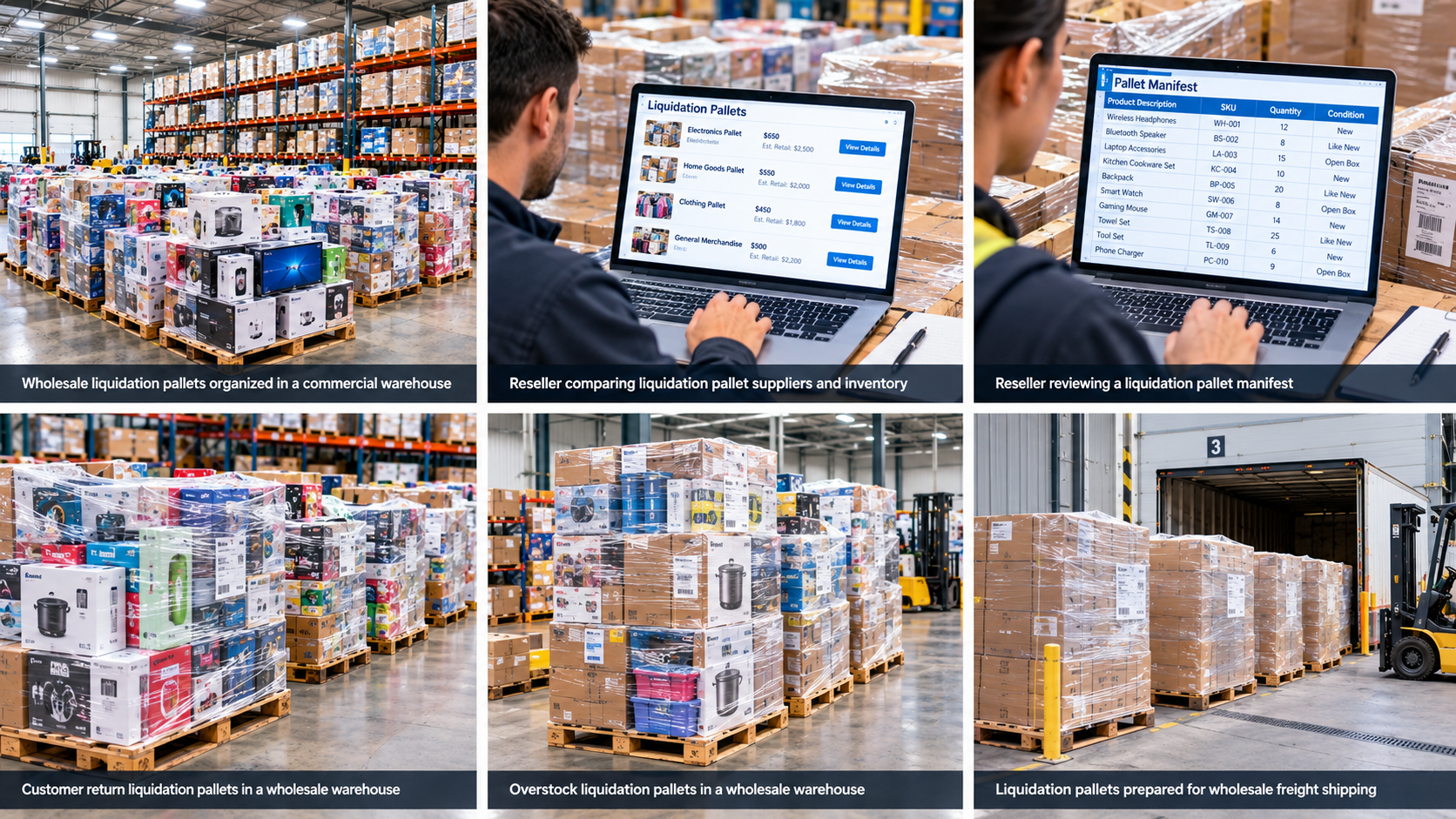
, understanding what you’re buying, calculating the total cost, and choosing inventory that fits your resale strategy.
This guide explains where to buy liquidation pallets, what types of suppliers to consider, how liquidation pallets work, what to check before purchasing, and how to make smarter wholesale buying decisions.
Where Can You Buy Liquidation Pallets?
There are several places where businesses and individual resellers can purchase liquidation pallets. The best option depends on your location, budget, product category, preferred condition, and whether you want to inspect inventory before buying.
Common sources include:
- Wholesale liquidation suppliers
- Liquidation marketplaces
- Retailer liquidation programs
- Local liquidation warehouses
- Customer return liquidation suppliers
- Overstock inventory suppliers
- Closeout and surplus distributors
- Online wholesale marketplaces
- Truckload and bulk liquidation suppliers
Each source has advantages and potential drawbacks. Comparing suppliers rather than choosing the first available pallet can help you make better purchasing decisions.
1. Wholesale Liquidation Suppliers
One of the most straightforward answers to where to buy liquidation pallets is through a dedicated wholesale liquidation supplier.
Liquidation suppliers specialize in moving surplus, returned, excess, discontinued, and closeout inventory. Depending on the supplier, merchandise may be available by the pallet, multiple pallets, or larger truckload quantities.
Wholesale liquidation pallets can be attractive because they allow resellers to purchase a large quantity of inventory in one transaction.
Popular categories may include:
Electronics Liquidation Pallets
Electronics pallets may contain headphones, speakers, computer accessories, smart devices, cables, accessories, and other consumer electronics.
Because electronics can have relatively high retail values, they can be attractive to experienced resellers. However, buyers should pay close attention to condition because returned electronics may require testing.
Clothing Liquidation Pallets
Clothing pallets can contain apparel, footwear, accessories, seasonal merchandise, and fashion items.
Clothing can be easier to store than many bulky products, although sizing, styles, seasons, and product condition should be considered before purchasing.
Home and Kitchen Pallets
Home goods and kitchen products are another common liquidation category. These pallets may contain cookware, storage products, small appliances, household accessories, décor, and other merchandise.
Tools and Hardware Pallets
Tools and hardware can appeal to resellers who already understand the category and know how to evaluate product condition and resale demand.
General Merchandise Pallets
General merchandise pallets may contain a mixture of product categories. These pallets can provide variety but may require more sorting and evaluation.
2. Liquidation Marketplaces
Online liquidation marketplaces are another option when researching where to buy liquidation pallets.
These platforms can connect buyers with liquidation inventory from different sellers, retailers, distributors, and liquidation companies.
Online marketplaces can make it easier to compare:
- Product categories
- Pallet quantities
- Inventory descriptions
- Condition
- Estimated retail value
- Location
- Shipping options
- Available manifests
- Seller information
Before purchasing through an online marketplace, read the listing carefully. Make sure you understand whether the inventory is new, open-box, customer returns, shelf pulls, salvage, or mixed condition.
3. Local Liquidation Warehouses
If you prefer to inspect merchandise before purchasing, a local liquidation warehouse can be a useful option.
Buying locally may also reduce the complexity of long-distance freight. Depending on the warehouse, buyers may be able to visit the facility, view available pallets, ask questions, and arrange pickup.
Searching for terms such as:
“liquidation pallets near me”
or
“where to buy liquidation pallets near me”
can help identify local options.
When visiting a liquidation warehouse, look at how inventory is stored and organized. A professional operation should make it reasonably clear what you’re purchasing and what condition the merchandise is expected to be in.
4. Customer Return Pallets
Customer return pallets are one of the most recognizable forms of liquidation inventory.
Retailers receive products back for many reasons. A customer may have ordered the wrong product, changed their mind, received a damaged item, or returned something that was simply no longer wanted.
Returned merchandise does not necessarily mean the product is defective. However, the condition can vary significantly.
A customer return pallet may include products that are:
- New and unopened
- Open box
- Used
- Missing accessories
- Damaged
- Untested
- In need of cleaning
- Suitable for parts or salvage
This is why understanding the condition of liquidation pallets is essential before buying.
5. Overstock Liquidation Pallets
Overstock inventory is merchandise that remains after a retailer or distributor has more inventory than it needs.
Unlike customer returns, overstock products may never have been purchased by a consumer.
Overstock pallets can include:
- Seasonal merchandise
- Excess inventory
- Previous-year products
- Packaging changes
- Discontinued products
- Slow-moving inventory
For resellers, overstock pallets can be appealing because products may have less wear than customer-return merchandise.
However, the fact that merchandise is listed as overstock does not automatically mean every item will sell quickly. Demand, seasonality, brand recognition, pricing, and competition still matter.
How to Choose the Best Place to Buy Liquidation Pallets
Knowing where to buy liquidation pallets is important, but knowing how to evaluate the supplier is even more important.
Before placing an order, consider these factors.
1. Product Condition
Always determine the expected condition of the merchandise.
Common descriptions include:
New: Merchandise is generally expected to be unused.
Open box: Packaging may have been opened, but the product may still be usable.
Customer returns: Products have previously been sold and returned.
Used: Merchandise has been previously used.
Salvage: Products may be damaged, incomplete, or suitable primarily for repair or parts.
Condition terminology can vary between suppliers, so ask questions if a listing is unclear.
2. Manifest Availability
A liquidation manifest can provide useful information about the contents of a pallet.
Depending on the supplier, a manifest may include:
- Product descriptions
- SKUs
- Quantities
- Product categories
- Retail values
- Condition information
A manifest is not necessarily a guarantee that every product will arrive in perfect resale condition. It should be treated as an important purchasing reference rather than a substitute for due diligence.
3. Total Purchase Cost
Don’t evaluate a pallet solely by its advertised price.
Your actual acquisition cost may include:
Pallet price + shipping + handling + taxes/fees + repair/cleaning costs = total acquisition cost
For example, a pallet that appears inexpensive can become significantly less attractive if freight costs are high or a large portion of the inventory requires additional work.
4. Shipping and Freight
Shipping is especially important when purchasing liquidation pallets online.
Ask:
- How is the pallet shipped?
- Is freight included?
- Is residential delivery available?
- Is a liftgate required?
- Can the pallet be picked up?
- How long will delivery take?
- Is the delivery address suitable for pallet freight?
Understanding freight costs before checkout can prevent unexpected expenses.
5. Supplier Transparency
A reliable supplier should provide clear information about the merchandise, condition, purchasing process, and applicable policies.
Look for clear product descriptions and purchasing terms.
Be cautious when a seller makes unrealistic promises about guaranteed profits or represents liquidation merchandise as risk-free inventory.
How Much Do Liquidation Pallets Cost?
There is no single price for a liquidation pallet.
Pricing depends on factors such as:
- Product category
- Number of items
- Condition
- Estimated retail value
- Brand mix
- Location
- Supplier
- Shipping costs
- Demand
- Whether the pallet is manifested
A small pallet of general merchandise may have a very different price from a pallet of electronics or a larger load of new inventory.
Instead of asking only “How much does a liquidation pallet cost?”, ask:
“What is my total landed cost, and what portion of this inventory can I realistically resell?”
This approach provides a more useful picture of potential profitability.
How to Calculate Potential Liquidation Pallet Profit
A simple calculation can help you evaluate a pallet before purchasing.
Start with your expected resale revenue and subtract all relevant costs.
Potential profit = Expected resale revenue − total acquisition costs − selling expenses
Selling expenses may include:
- Marketplace fees
- Payment processing
- Shipping to customers
- Packaging
- Storage
- Cleaning
- Repairs
- Labor
- Returns
For example, suppose you purchase a pallet for $600 and spend another $250 on freight and preparation.
Your initial cost is:
$600 + $250 = $850
If you eventually generate $1,400 in sales but incur $250 in selling and fulfillment expenses, your estimated profit would be:
$1,400 − $850 − $250 = $300
This is only an example. Actual results depend on the inventory, resale prices, sell-through rate, expenses, and market demand.
What Should You Look for in a Liquidation Pallet?
The best liquidation pallet isn’t necessarily the one with the highest advertised retail value.
Instead, look for inventory that matches your ability to sell it.
Consider:
Demand
Are customers actually looking for these products?
Resale Channels
Can you sell the products through your existing store, website, marketplace, flea market, discount store, or other channel?
Condition
Do you have the skills and resources to test, clean, repair, or repackage merchandise?
Storage
Can you store the pallet safely and efficiently?
Shipping
Are the products inexpensive and practical to ship to your customers?
Seasonality
Will the products remain desirable when you receive them?
A lower-value pallet with consistent demand can sometimes be more useful than a pallet with a high theoretical retail value but limited resale demand.
Common Mistakes When Buying Liquidation Pallets
New buyers can make expensive mistakes if they focus only on the advertised discount.
Mistake 1: Buying Based Only on Retail Value
Estimated retail value does not equal resale revenue.
A product may have a high original retail price but sell for much less on the secondary market.
Mistake 2: Ignoring Freight Costs
Freight can significantly change the economics of a pallet purchase.
Always calculate your landed cost before buying.
Mistake 3: Assuming Returns Are New
Customer returns can range from unopened merchandise to damaged or incomplete products.
Understand the condition category before purchasing.
Mistake 4: Buying Without a Resale Plan
Before purchasing a pallet, know where you intend to sell the inventory.
Mistake 5: Purchasing Too Much Too Soon
If you’re new to liquidation, starting with a manageable quantity can allow you to learn how sourcing, testing, listing, storage, and fulfillment work before scaling.
Are Liquidation Pallets Worth Buying?
Liquidation pallets can be worthwhile for buyers who understand the risks and have a clear resale strategy.
The opportunity comes from acquiring inventory below traditional retail pricing and selling individual products through appropriate resale channels.
However, liquidation is not guaranteed profit.
Your results can depend on:
- What products you receive
- Product condition
- Acquisition cost
- Freight
- Resale demand
- Selling fees
- Time required to process inventory
- Your ability to price and market products effectively
The best approach is to treat liquidation buying as an inventory business rather than a guaranteed bargain.
Where to Buy Liquidation Pallets Online
If you are specifically searching for where to buy liquidation pallets online, start by comparing established wholesale liquidation suppliers and marketplaces.
Before ordering, review:
- The product description
- Condition information
- Manifest availability
- Photos
- Quantity
- Supplier policies
- Shipping costs
- Payment terms
- Return or dispute policies
- Estimated resale demand
Don’t purchase simply because a listing claims a large discount.
A good liquidation purchase is one where the numbers, inventory quality, and resale strategy make sense together.
Tips for First-Time Liquidation Buyers
If this is your first liquidation pallet purchase, keep the process simple.
Start with a product category you understand. Choose inventory that you already know how to price and sell.
Review the manifest if one is available. Research several of the products rather than assuming the entire pallet has the same resale potential.
Calculate your total costs before ordering.
Once the pallet arrives, sort the inventory into categories such as:
- Ready to sell
- Needs cleaning
- Needs testing
- Needs repair
- Parts/salvage
- Unsellable
This process helps you understand your actual recovery rate and improves future buying decisions.
Finding the Right Liquidation Pallet Supplier
The best supplier depends on your specific business model.
A local reseller may prefer a nearby liquidation warehouse where pallets can be inspected or picked up.
An online seller may prefer a supplier offering nationwide freight delivery and detailed manifests.
A larger wholesale operation may be more interested in truckloads or recurring bulk inventory.
Rather than asking which supplier is universally the best, ask:
Which supplier offers the right inventory, condition, pricing, shipping, and purchasing terms for my business?
That is the more useful question.
Start Buying Liquidation Pallets With a Plan
If you’re still researching where to buy liquidation pallets, focus on building a repeatable sourcing process.
Compare suppliers. Review inventory condition. Study manifests. Calculate landed costs. Research resale prices. Consider shipping. Start with manageable quantities and track your results.
Over time, your purchasing decisions can become more data-driven.
The goal isn’t simply to buy cheap merchandise. The goal is to acquire resalable inventory at a cost that supports a sustainable business.
Whether you’re looking for customer returns, overstock, electronics, clothing, tools, home goods, or general merchandise, careful sourcing can help you make better liquidation purchasing decisions.
Frequently Asked Questions
Where is the best place to buy liquidation pallets?
The best place depends on your product category, location, budget, and resale strategy. Options include wholesale liquidation suppliers, online liquidation marketplaces, retailer liquidation programs, and local liquidation warehouses.
Can I buy liquidation pallets online?
Yes. Many liquidation suppliers and marketplaces offer pallets for online purchase and arrange freight delivery. Always review the condition, manifest, shipping charges, and purchasing terms before ordering.
Are liquidation pallets profitable?
They can be, but profitability is not guaranteed. Your results depend on inventory quality, purchase price, freight, resale demand, selling fees, processing costs, and how effectively you sell the merchandise.
What are customer return pallets?
Customer return pallets contain merchandise previously purchased and returned by consumers. The condition can vary from unopened or like-new products to used, damaged, incomplete, or untested merchandise.
What is an overstock liquidation pallet?
An overstock pallet contains excess inventory that a retailer, distributor, or other seller needs to move. Overstock products may include seasonal, discontinued, excess, or slow-moving merchandise.
Should I buy manifested liquidation pallets?
A manifest can make it easier to evaluate the potential contents of a pallet before buying. It can provide product descriptions, quantities, SKUs, and other information, depending on the supplier.
How much money do I need to buy a liquidation pallet?
There is no universal minimum. Pallet prices vary by category, condition, quantity, supplier, and location. Remember to include freight and other acquisition costs in your budget.
Can beginners buy liquidation pallets?
Yes. Beginners can start with smaller quantities and familiar product categories. Learning how to evaluate condition, pricing, manifests, shipping, and resale demand is important before scaling up.
Where can I buy liquidation pallets near me?
Search for local liquidation warehouses, wholesale surplus businesses, and liquidation distributors in your area. Local purchasing may provide opportunities to inspect inventory or arrange pickup, depending on the supplier.
Final Takeaway
Knowing where to buy liquidation pallets is only the beginning. Successful liquidation sourcing requires careful supplier selection, realistic inventory valuation, condition assessment, freight planning, and a clear resale strategy.
Whether you choose wholesale liquidation pallets, customer returns, overstock inventory, or specialized categories such as electronics and clothing, evaluate the complete economics of the purchase before committing.
When you focus on quality inventory, transparent sourcing, manageable costs, and genuine resale demand, liquidation pallets can become a valuable part of a broader wholesale sourcing strategy.