Amazon Overstock Pallets: Buy Wholesale Inventory for Resale
Amazon overstock pallets are an increasingly popular source of wholesale inventory for resellers, discount retailers, ecommerce businesses, flea-market vendors, and entrepreneurs looking to purchase merchandise below traditional retail pricing.
Retailers and fulfillment operations regularly deal with excess inventory, products that did not sell as expected, seasonal merchandise, discontinued items, and other inventory that needs to be moved through alternative channels. Overstock liquidation allows business buyers to purchase this merchandise in larger quantities and resell individual products through online marketplaces, local stores, websites, flea markets, and other sales channels.
For buyers, the opportunity is attractive: instead of purchasing products individually at retail or traditional wholesale prices, you can potentially acquire entire pallets of merchandise at discounted liquidation prices.
However, buying Amazon overstock pallets successfully requires more than finding a low price. You need to understand inventory condition, manifests, shipping, product demand, resale prices, storage, operating expenses, and your maximum profitable purchase price.
This guide explains what Amazon overstock pallets are, where to buy them, what products you may find, how to evaluate a pallet, how to estimate profitability, and how to avoid common liquidation-buying mistakes.
What Are Amazon Overstock Pallets?
Amazon overstock pallets are pallets or larger lots of merchandise classified as excess or overstock inventory.
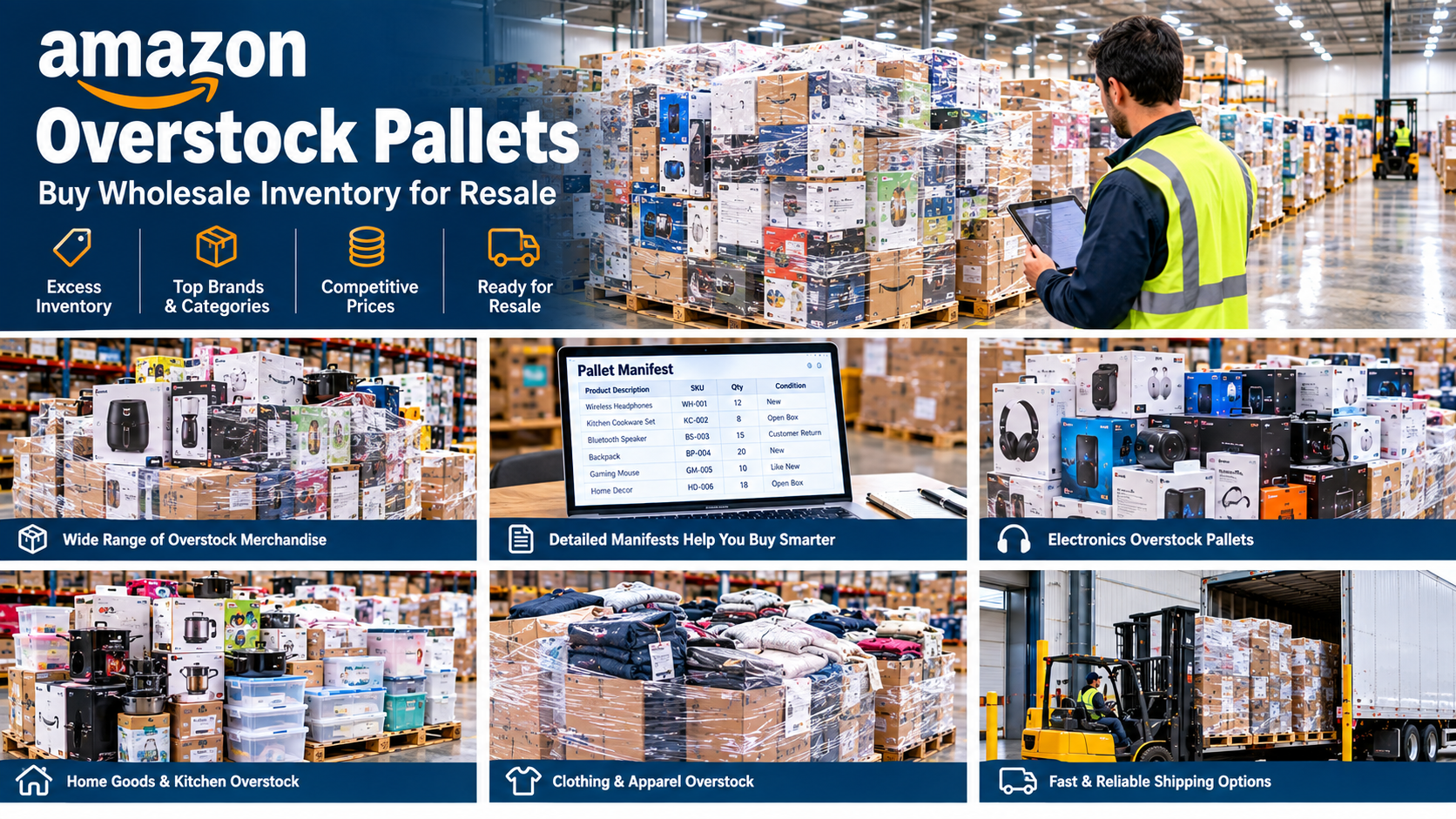
that remain available after normal retail demand, purchasing forecasts, seasonal sales, or inventory requirements have changed. Instead of keeping excess merchandise in the regular retail supply chain indefinitely, inventory can be liquidated through specialized B2B marketplaces.
Amazon’s official B2B liquidation storefront is operated through B-Stock. The marketplace identifies overstock, customer returns, and warehouse-damaged merchandise among its inventory types. Available lots can range in size, from smaller pallet quantities to larger shipments.
Products can span numerous categories, including:
- Electronics
- Home goods
- Kitchen products
- Apparel
- Footwear
- Toys
- Sports products
- Consumer merchandise
- Office products
- Tools
- General merchandise
The exact products and quantities available change frequently, so buyers should evaluate each individual auction rather than assuming every Amazon overstock pallet contains the same type of merchandise.
Why Buy Amazon Overstock Pallets?
There are several reasons resellers consider overstock pallets as a source of inventory.
Wholesale Pricing
Liquidation inventory can be offered at prices substantially below the original retail value.
This creates an opportunity for a reseller to purchase merchandise in bulk and sell individual products at market prices.
Large Inventory Lots
Buying a pallet allows you to acquire many products in one transaction rather than sourcing every item separately.
For businesses with established sales channels, this can make inventory acquisition more efficient.
Product Variety
Amazon overstock inventory can cover numerous product categories.
That means buyers can potentially build specialized businesses around categories such as electronics or home goods, or purchase general merchandise for multiple sales channels.
Resale Opportunities
A pallet can be divided into individual products, bundles, product lots, or wholesale packages.
For example, a reseller might purchase a mixed pallet and sell:
- High-value products individually
- Small accessories in bundles
- Low-value items in multi-item lots
- Bulky products locally
- Slow-moving inventory through clearance promotions
The ability to separate a pallet into smaller saleable units is one of the key advantages of liquidation inventory.
Where to Buy Amazon Overstock Pallets
The most important consideration when sourcing liquidation inventory is the supplier.
Not every website advertising “Amazon pallets” is directly connected to Amazon.
For buyers looking specifically for official Amazon liquidation inventory, the Amazon Liquidation Auctions marketplace on B-Stock is the primary marketplace to investigate. It describes itself as Amazon’s official B2B liquidation storefront and gives qualified U.S.-based business buyers access to inventory.
You can also find Amazon-related liquidation listings through broader B-Stock marketplaces, where returned, overstock, and new-condition inventory from major retailers and manufacturers is offered to business buyers.
When evaluating another liquidation supplier, look for:
- A verifiable business identity
- Clear inventory descriptions
- Manifests when available
- Transparent shipping costs
- Clear terms and conditions
- Product-condition information
- Established customer support
- A physical business presence where appropriate
- Secure payment methods
Be cautious of websites promising guaranteed high-value products or extremely expensive merchandise for unrealistically low prices.
How Amazon Overstock Pallets Work
The purchasing process is different from ordinary ecommerce.
On the official Amazon U.S. Liquidation Auctions marketplace, prospective buyers must create an account and provide the required business information. The marketplace currently requires a valid reseller’s certificate for approval, and its U.S. marketplace is limited to buyers in the lower 48 contiguous states.
Once approved, buyers can review available listings and evaluate individual lots.
A typical buying process involves:
- Registering as a qualified business buyer
- Browsing available liquidation listings
- Reviewing the auction details
- Examining the product information and manifest
- Calculating realistic resale value
- Checking shipping costs
- Setting a maximum bid
- Placing a bid
- Winning and paying for the inventory
- Receiving and processing the shipment
- Testing, sorting, cleaning, or preparing products
- Listing products for resale
B-Stock’s broader registration information indicates that buyers may be asked for business location, EIN, reseller tax ID, shipping address, and contact information.
Amazon Overstock Pallets vs. Customer Return Pallets
One of the most important distinctions in liquidation is the difference between overstock and customer returns.
Amazon Overstock Pallets
Overstock merchandise is excess inventory that has not necessarily gone through the same customer-use cycle as returned merchandise.
Depending on the listing, overstock products can be attractive to resellers because they may require less testing or refurbishment than customer-return merchandise.
However, overstock is not automatically guaranteed to be new or in perfect resale condition. Buyers should always review the specific auction’s condition description.
Amazon Customer Return Pallets
Customer returns have previously been purchased and returned by consumers.
A returned product could be:
- Unopened
- Open-box
- Lightly used
- Missing accessories
- Damaged
- Defective
- In need of testing
- In need of cleaning
Amazon’s marketplace specifically identifies both overstock and customer returns among its inventory types.
For beginners, understanding this distinction is essential.
A pallet of overstock inventory and a pallet of customer returns should not automatically receive the same valuation.
Types of Amazon Overstock Pallets
The products available change frequently, but several categories can be particularly interesting to resellers.
Amazon Electronics Overstock Pallets
Electronics can offer attractive resale opportunities because individual products may have relatively high selling prices.
Potential products can include:
- Headphones
- Speakers
- Computer accessories
- Smart-home products
- Chargers
- Cables
- Gaming accessories
- Small consumer electronics
Electronics should be evaluated carefully because technology changes quickly.
A product that was popular several years ago may have significantly lower demand today.
Before purchasing an electronics pallet, research:
- Current model numbers
- Retail prices
- Used prices
- Open-box prices
- Compatibility
- Accessories
- Warranty considerations
- Current competition
Home & Kitchen Overstock Pallets
Home and kitchen inventory can be attractive because there is consistent consumer demand for everyday household products.
Potential products include:
- Kitchen appliances
- Cookware
- Storage products
- Home décor
- Organization products
- Bedding
- Small appliances
- Household accessories
These products can work well for both online and local resale.
Clothing Overstock Pallets
Apparel liquidation can include:
- Shirts
- Pants
- Jackets
- Shoes
- Children’s clothing
- Accessories
- Seasonal merchandise
The biggest challenge is often size distribution.
A pallet containing many unpopular sizes or highly seasonal products may take longer to sell than expected.
Toys and General Merchandise
Mixed general merchandise can provide diversification.
A pallet might contain products from multiple categories, allowing a reseller to experiment with different sales channels.
The trade-off is that mixed pallets can require more sorting, product knowledge, photography, and listing work.
How to Read an Amazon Overstock Pallet Manifest
A manifest is one of the most valuable tools available to a liquidation buyer.
It can provide information about the products and quantities included in a lot.
Depending on the listing, information may include:
- Product descriptions
- Quantities
- Product identifiers
- Estimated retail value
- Product condition
- Pallet quantities
- Shipment information
However, never assume that the manifest’s retail values equal your potential resale revenue.
Instead, research the actual market.
For each significant product, ask:
What can I realistically sell this item for today?
Then consider marketplace fees, shipping, discounts, returns, and other expenses.
Example
Suppose a pallet contains products with a combined estimated retail value of $8,000.
You should not automatically bid $4,000 because the inventory is supposedly worth $8,000.
Instead, you might estimate realistic resale revenue at $5,000.
Then subtract:
- Purchase price
- Freight
- Selling fees
- Testing
- Repairs
- Packaging
- Labor
- Storage
- Expected discounts
- Returns
The amount remaining is your potential operating profit.
How Much Do Amazon Overstock Pallets Cost?
There is no single fixed price for an Amazon overstock pallet.
Pricing varies according to:
- Product category
- Product quantity
- Estimated retail value
- Condition
- Location
- Demand
- Current auction competition
- Shipping
- Lot size
- Brand mix
Some lots may consist of a single pallet, while others can involve multiple pallets or larger shipments.
The official marketplace states that lots are available in different sizes.
This means buyers should avoid searching for one universal “Amazon pallet price.”
Instead, calculate the economics of each individual lot.
How to Calculate Your Maximum Bid
One of the most important liquidation-buying skills is determining your maximum bid before the auction becomes competitive.
Use a simple formula:
Maximum Purchase Price = Expected Resale Revenue − All Other Costs − Desired Profit
For example:
Expected resale revenue: $5,000
Shipping: $500
Testing and repairs: $250
Selling expenses: $400
Packaging: $150
Desired profit: $1,200
Maximum purchase price:
$5,000 − $500 − $250 − $400 − $150 − $1,200 = $2,500
In this example, paying substantially more than $2,500 would reduce the desired profit.
The actual calculation should be based on your own business costs and realistic selling prices.
Don’t Use Retail Value as Your Profit Estimate
Retail value is useful for understanding the approximate scale of inventory, but it is not the same thing as resale revenue.
Consider a pallet advertised with a $10,000 estimated retail value.
If the products are realistically worth $6,000 on the secondary market, you should build your calculations around the $6,000 figure—not $10,000.
Then account for products that may:
- Sell below expected prices
- Take months to sell
- Need repairs
- Be missing components
- Require discounts
- Become obsolete
- Never sell
A conservative valuation is usually safer than an optimistic one.
Amazon Overstock Pallet Shipping Costs
Shipping can have a major impact on liquidation profitability.
On the standard Amazon Liquidation Auctions shipping program, shipping is automatically calculated on the live auction page. Buyers generally cannot arrange their own shipping or pick up orders themselves. Standard orders can take up to 28 days after payment to ship.
The number of pallets and shipment weight displayed on an auction are estimates.
Orders can ship through LTL freight, while some smaller shipments may move by parcel. Multiple-pallet orders may also arrive separately.
Therefore, always calculate:
Winning bid + shipping = acquisition cost
Then add your other operating expenses.
For example:
Auction price: $1,800
Shipping: $450
Total acquisition cost: $2,250
If you only evaluate the $1,800 auction price, your profit estimate will be inaccurate.
Receiving and Unloading Overstock Pallets
Freight delivery requires preparation.
A pallet shipment may require:
- Loading dock
- Forklift
- Pallet jack
- Liftgate
- Adequate receiving space
- Staff for unloading
- Clear access for the freight carrier
B-Stock’s current Amazon shipping information recommends using a receiving location with a loading dock or forklift where possible. Buyers are responsible for unloading, and additional liftgate, residential, or unloading/lumper fees may apply depending on the shipment.
Before ordering a pallet, make sure your delivery location can physically receive it.
B-Stock Blue and Amazon Overstock Inventory
Some Amazon listings may be designated as B-Stock Blue.
According to the current shipping information, B-Stock Blue uses centralized processing and offers features such as third-party verified manifests, shipment tracking, reduced shortages, and full-order fulfillment. Orders typically ship within three business days of payment, subject to delivery scheduling.
For buyers who prioritize predictable fulfillment, these listings can be worth examining separately.
Always review the specific auction’s terms rather than assuming every listing has identical shipping or fulfillment conditions.
Are Amazon Overstock Pallets Profitable?
They can be, but profitability is never guaranteed.
A profitable liquidation business depends on buying correctly and selling efficiently.
Your results can depend on:
- Acquisition price
- Product condition
- Product demand
- Resale channel
- Selling fees
- Shipping
- Labor
- Storage
- Returns
- Repairs
- Sell-through rate
The best liquidation buyers are not necessarily the people who find the cheapest pallets.
They are the buyers who consistently understand what the inventory is worth before purchasing it.
Where to Resell Amazon Overstock Products
Once you receive a pallet, you need a plan for converting inventory into revenue.
Online Marketplaces
Individual products can be listed online when they have recognizable brands, model numbers, and consistent demand.
Online sales are particularly useful for products that are:
- Small
- Easy to ship
- Easy to photograph
- Easy to describe
- In demand
Your Own Ecommerce Store
A dedicated ecommerce store can give you greater control over branding, pricing, customer relationships, and promotions.
It can be particularly useful once you have a repeatable inventory source.
Local Marketplaces
Local sales can be ideal for:
- Furniture
- Appliances
- Large home goods
- Bulky products
- Low-value products where shipping is uneconomical
Local sales can eliminate some outbound shipping expenses.
Flea Markets and Discount Stores
A physical selling environment can work well for inexpensive general merchandise.
Instead of individually listing hundreds of products, you can display large quantities and sell directly to consumers.
Wholesale Bundles
Another option is to break a pallet into smaller wholesale lots.
For example:
- 10-piece kitchen bundles
- Electronics accessory lots
- Clothing bundles
- Toy lots
- Home organization bundles
This can help move lower-value products faster.
How to Make Money With Amazon Overstock Pallets
Successful pallet reselling is about building a repeatable system.
Start With a Product Category You Understand
Specialization makes inventory valuation easier.
If you understand electronics, you can quickly identify:
- Older models
- Popular brands
- High-demand accessories
- Obsolete products
- Products with strong resale values
Track Every Expense
Record:
- Winning bid
- Shipping
- Taxes
- Repairs
- Labor
- Packaging
- Marketplace fees
- Revenue
- Unsold inventory
Without accurate records, you may believe a pallet was profitable when it was not.
Prioritize Sell-Through
A $1,000 profit that takes twelve months may be less attractive than a $500 profit generated within a few weeks.
Inventory turnover affects cash flow.
Separate Products by Value
When the pallet arrives, sort products into categories such as:
A: High-value, fast-moving products
B: Moderate-value products
C: Low-value products
D: Damaged or repair inventory
List the highest-value products first to recover your capital faster.
Common Amazon Overstock Pallet Buying Mistakes
1. Buying Because the Retail Value Looks High
Estimated retail value does not equal guaranteed resale revenue.
Always calculate market-based resale value.
2. Ignoring Freight
A low auction price can become expensive after shipping.
Always calculate landed cost.
3. Bidding Emotionally
Auction competition can encourage buyers to keep increasing their bids.
Set a maximum bid and stick to it.
4. Buying Categories You Don’t Understand
A complicated electronics pallet may be difficult for a reseller who has no testing equipment or product knowledge.
Choose inventory you can process efficiently.
5. Underestimating Labor
Sorting, testing, cleaning, photographing, listing, packaging, and customer service all take time.
6. Running Out of Storage
A successful pallet purchase still becomes a problem if you have nowhere to put the inventory.
7. Assuming Every Product Will Sell
Some inventory will move quickly.
Some will require discounts.
Some may remain unsold.
Build this reality into your calculations.
Amazon Overstock Pallets: Beginner Buying Checklist
Before placing a bid, ask:
Inventory
- What products are included?
- How many units are listed?
- What condition are they?
- Is a manifest available?
- Are products concentrated in one category?
Pricing
- What is the realistic resale value?
- What is my maximum bid?
- How much is shipping?
- What are my expected selling fees?
Operations
- Can I receive the shipment?
- Do I have enough storage?
- Can I test or inspect the products?
- How quickly can I list them?
Sales
- Where will I sell?
- What are current market prices?
- How competitive is the category?
- How quickly are similar products selling?
If you cannot answer these questions, the pallet may not be ready for bidding.