What Is a Liquidation Warehouse?
A liquidation warehouse is a commercial facility where excess, overstock, customer returns, discontinued products, closeouts, surplus merchandise, and other inventory are collected and sold, frequently at prices below traditional retail.
Unlike a standard retail store, a
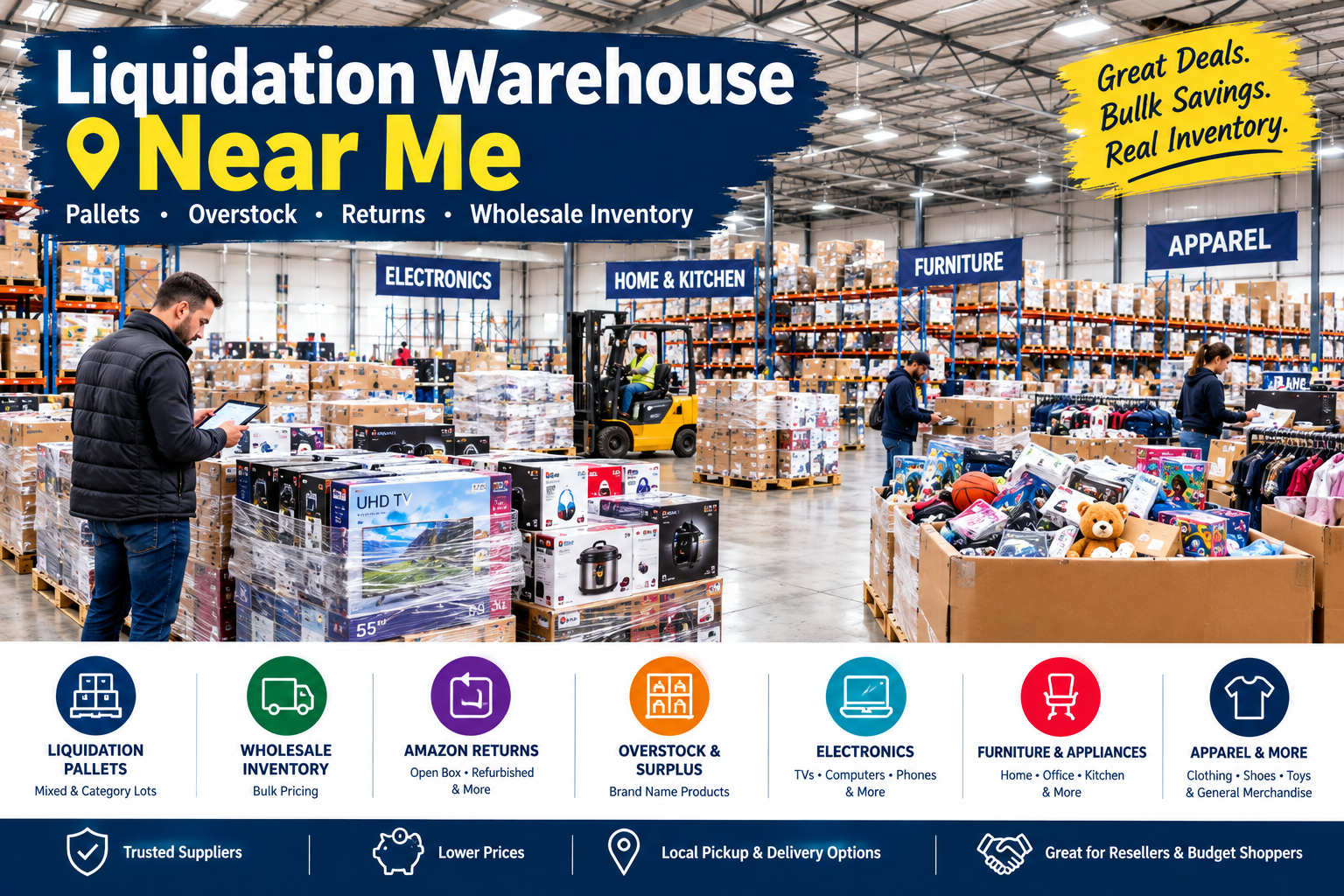
. Depending on the supplier, customers may be able to purchase individual products, cases, pallets, multiple pallets, or larger wholesale lots.
For a person searching “liquidation warehouse near me,” the objective is usually to find a convenient local source for affordable merchandise that can be purchased for personal use or resale.
Liquidation warehouses can be particularly attractive to entrepreneurs because they provide access to large quantities of products without requiring traditional manufacturer-direct wholesale relationships.
However, liquidation inventory is different from conventional wholesale inventory. Product condition, quantities, packaging, manifests, and availability can vary significantly from one lot to another.
That means successful buyers need to evaluate each opportunity rather than assuming every liquidation pallet is profitable.
Where Does Liquidation Warehouse Inventory Come From?
Understanding the source of the merchandise is one of the most important parts of liquidation buying.
A warehouse can receive inventory from several different channels.
Customer Returns
Retail customers return products for many reasons.
A returned product might be:
- Unopened
- Like new
- Open box
- Used
- Damaged
- Missing accessories
- Non-functional
Never assume that a returned product is defective, but never assume that it is new either.
Overstock
Overstock occurs when a retailer has more merchandise than it currently needs.
This can happen because demand was lower than expected, purchasing quantities were too high, or the business is changing its product assortment.
Overstock can be attractive to resellers because some products may remain new and packaged.
Excess Inventory
Excess inventory is merchandise that has become surplus to a company’s current requirements.
Businesses may liquidate excess inventory to recover capital and free warehouse space.
Discontinued Products
When a retailer stops selling a particular product, remaining inventory may be moved through closeout or liquidation channels.
Shelf Pulls
Shelf pulls are products removed from retail shelves, often because a product is being replaced, discontinued, repackaged, or otherwise removed from normal retail circulation.
Business Closures
When businesses close, reorganize, or liquidate assets, their remaining inventory may enter wholesale liquidation channels.
How to Find a Liquidation Warehouse Near Me
Searching for “liquidation warehouse near me” is only the beginning.
Use several related searches to uncover more local suppliers:
- liquidation warehouse near me
- liquidation warehouses near me
- liquidation pallets near me
- wholesale liquidation near me
- wholesale pallets near me
- surplus warehouse near me
- overstock warehouse near me
- Amazon return warehouse near me
- liquidation inventory near me
- pallet liquidation warehouse
- discount warehouse near me
Different businesses use different terminology.
One company may call itself a liquidation warehouse, while another may describe itself as a surplus warehouse, wholesale outlet, returns center, closeout warehouse, or pallet supplier.
Search engines and map platforms may therefore return different results depending on the wording you use.
When evaluating a local supplier, look beyond the business name.
Check:
- Location
- Hours
- Website
- Customer reviews
- Product categories
- Purchasing requirements
- Pickup options
- Delivery options
- Inventory condition
- Minimum order quantities
If you’re searching for a physical location, confirm the business is currently operating before making a long trip.
Liquidation Warehouse vs. Liquidation Store
The two terms are often used interchangeably, but their business models can be different.
Liquidation Store
A liquidation store generally sells products directly to consumers.
Merchandise is often displayed individually so shoppers can inspect products and purchase only the items they want.
Liquidation Warehouse
A liquidation warehouse is more likely to handle inventory in bulk.
Depending on the supplier, buyers may purchase:
- Cases
- Pallets
- Multiple pallets
- Wholesale lots
- Truckloads
Some businesses combine both models.
A warehouse might sell pallets to resellers while also operating a retail area for individual shoppers.
Which Is Better?
It depends on your goal.
If you are looking for a few discounted products for personal use, a liquidation store may be more convenient.
If you’re sourcing inventory for resale, a liquidation warehouse near you may provide more useful purchasing options.
What Can You Buy at a Liquidation Warehouse?
One of the biggest advantages of liquidation sourcing is the variety of products available.
Inventory changes constantly, but common categories include:
Electronics
Potential products include:
- Headphones
- Speakers
- Computer accessories
- Gaming accessories
- Cameras
- Smart devices
- Chargers
- TVs
- Small electronics
Electronics can have strong resale potential, but buyers should account for testing, missing accessories, cosmetic damage, and product functionality.
Home & Kitchen
Liquidation warehouses may carry:
- Cookware
- Small appliances
- Kitchen accessories
- Storage products
- Furniture
- Lighting
- Home décor
- Cleaning products
Local buyers can have an advantage with larger household products because they may avoid some long-distance shipping costs.
Apparel
Possible inventory includes:
- Clothing
- Shoes
- Jackets
- Children’s apparel
- Accessories
- Seasonal merchandise
Resellers should evaluate sizes, brands, styles, condition, and seasonality before purchasing large clothing lots.
Tools & Hardware
Depending on the supplier, inventory can include:
- Hand tools
- Power-tool accessories
- Hardware
- Workshop products
- Outdoor equipment
Toys & Games
Liquidation inventory can include:
- Toys
- Games
- Educational products
- Outdoor products
- Seasonal children’s merchandise
Furniture & Appliances
Larger liquidation warehouses may carry:
- Furniture
- Mattresses
- Small appliances
- Large appliances
- Home improvement products
These categories can work especially well for local resale.
Liquidation Pallets Near Me
One of the highest-value searches related to liquidation warehouses is “liquidation pallets near me.”
A liquidation pallet contains multiple products packaged together for transportation and resale.
A pallet may contain a single product category or a mixture of merchandise.
For example, a pallet could contain:
Electronics: headphones, speakers, accessories and smart devices.
Home goods: kitchen products, storage items and household accessories.
Mixed merchandise: electronics, apparel, toys, tools and home products.
Before buying, determine whether the pallet is:
- Manifested
- Unmanifested
- New
- Overstock
- Returned
- Used
- Damaged
- Untested
The more information you have about the lot, the easier it becomes to estimate its potential value.
How to Evaluate a Liquidation Pallet
A common mistake among new liquidation buyers is focusing exclusively on the advertised retail value.
Instead, calculate realistic resale value.
Step 1: Review the Inventory
If a manifest is available, review:
- Product descriptions
- SKUs
- Quantities
- Brands
- Condition
- Estimated retail value
Step 2: Research Market Prices
Check actual selling prices on the marketplaces where you plan to sell.
Don’t automatically assume that a product with a $100 retail price will generate $100 in resale revenue.
Step 3: Estimate Unsellable Inventory
Some products may require:
- Cleaning
- Testing
- Repairs
- Missing parts
- Discounting
- Recycling
Include expected losses in your calculations.
Step 4: Calculate Your Landed Cost
Use:
Landed Cost = Purchase Price + Transportation + Processing Costs
Then compare the landed cost with realistic revenue.
How Much Does a Liquidation Pallet Cost?
There is no universal liquidation pallet price.
Pricing depends on:
- Product category
- Number of units
- Condition
- Brand
- Demand
- Location
- Shipping
- Seller
- Lot size
- Sales format
A pallet of consumer electronics can have a very different price from a pallet of clothing or general merchandise.
The most important number isn’t the advertised retail value.
It’s your maximum purchase price.
How to Calculate Your Maximum Purchase Price
A useful formula is:
Maximum Purchase Price = Expected Resale Revenue − All Other Costs − Desired Profit
Suppose you estimate that a pallet can realistically produce:
$5,000 in resale revenue
Your estimated costs are:
- Transportation: $500
- Marketplace fees: $700
- Repairs and preparation: $300
- Packaging: $150
- Expected losses: $250
- Desired profit: $1,200
Your maximum purchase price would be:
$5,000 − $500 − $700 − $300 − $150 − $250 − $1,200 = $1,900
If the seller wants significantly more than $1,900, you may need to walk away.
This discipline is especially important in competitive liquidation auctions, where buyers can become emotionally invested in winning a particular lot.
Local Pickup vs. Delivery
A major advantage of sourcing from a liquidation warehouse near you can be convenience.
Local pickup may reduce:
- Transportation distance
- Waiting time
- Freight complexity
- Handling costs
However, not every warehouse allows customers to pick up pallets.
Some suppliers require delivery through their own logistics network or third-party carriers.
Always confirm:
- Pickup availability
- Pickup hours
- Loading requirements
- Vehicle requirements
- Delivery area
- Freight charges
- Residential delivery restrictions
- Liftgate requirements
A pallet can be profitable on paper but unprofitable after transportation expenses.
How to Inspect Liquidation Inventory
If the warehouse permits inspection, take advantage of it.
Check Packaging
Look for:
- Crushed boxes
- Broken seals
- Water damage
- Missing labels
- Excessive wear
Check Products
Inspect for:
- Cracks
- Scratches
- Missing components
- Signs of use
- Physical damage
Test Electronics
If testing is permitted, verify functionality before assigning full resale value.
Verify Quantities
For larger lots, compare the physical inventory against available documentation.
Photograph Important Damage
If you’re buying inventory for resale, documenting the condition can help you organize your listings and pricing later.
Buying Amazon Return Inventory Locally
Many people searching for “Amazon liquidation warehouse near me” are actually looking for Amazon return merchandise.
It is important to understand that a local business selling Amazon returns is not necessarily an official Amazon retail location.
Independent liquidation businesses can acquire returned, overstock, surplus, or other liquidation merchandise and then resell it locally.
The official Amazon U.S. Liquidation Auctions marketplace is operated through B-Stock and is designed for qualified U.S.-based business buyers. Its inventory can include overstock, customer returns and warehouse-damaged merchandise. (bstock.com)
For local buyers, the key question is not simply whether merchandise originated from Amazon.
You should also ask:
What condition is it in, how was it processed, and what exactly am I buying?
Best U.S. Markets for Liquidation Warehouses
Liquidation warehouses are particularly useful in large commercial and population centers where there is substantial retail activity and distribution infrastructure.
Potential markets to investigate include:
Texas
- Dallas
- Houston
- San Antonio
- Austin
- Fort Worth
California
- Los Angeles
- San Diego
- Sacramento
- San Jose
- Inland Empire
Florida
- Miami
- Orlando
- Tampa
- Jacksonville
Georgia
- Atlanta
- Savannah
Illinois
- Chicago
- Joliet
Ohio
- Columbus
- Cleveland
- Cincinnati
New York
- New York City
- Buffalo
- Rochester
Pennsylvania
- Philadelphia
- Pittsburgh
Arizona
- Phoenix
- Tucson
The availability of liquidation suppliers varies by city, so buyers should verify current local businesses rather than assuming every major city has the same inventory options.
How to Choose the Best Liquidation Warehouse Near You
The closest warehouse isn’t always the best warehouse.
Evaluate suppliers based on several factors.
Inventory Quality
Does the warehouse consistently offer products you can sell?
Pricing
Are the prices low enough to leave room for your costs and profit?
Transparency
Does the supplier clearly explain product condition and purchasing terms?
Inventory Turnover
Does the warehouse receive new merchandise regularly?
Location
Is it convenient enough for repeat purchasing?
Customer Service
Can you get clear answers about inventory and purchasing?
Reseller Opportunities
Does the supplier offer discounts for multiple pallets or larger purchases?
A good liquidation supplier can become an important long-term sourcing partner.
How to Avoid Liquidation Warehouse Scams
Before paying an unfamiliar supplier, investigate the business carefully.
Warning Signs
Be cautious when you encounter:
- Unrealistic discounts
- No verifiable physical address
- Pressure to pay immediately
- Limited business information
- Poor communication
- Stock photos instead of actual inventory
- Unusual payment requests
- No clear purchasing terms
- No explanation of product condition
If a deal appears dramatically better than every comparable offer, investigate before sending money.
A legitimate warehouse should be able to provide basic information about its business and merchandise.
How to Resell Liquidation Warehouse Inventory
Once you purchase inventory, your work has only begun.
A successful resale operation needs a process.
1. Sort the Inventory
Separate products by:
- Category
- Condition
- Brand
- Value
- Selling channel
2. Test Products
Especially important for electronics and appliances.
3. Clean Products
Presentation can significantly affect customer perception.
4. Photograph Merchandise
Use clear, consistent photos.
5. Create Listings
Write accurate descriptions and disclose condition.
6. Price Competitively
Research current market prices.
7. Track Inventory
Use spreadsheets or inventory software to avoid losing track of products.
8. Discount Slow-Moving Products
Inventory that sits too long ties up your capital and storage space.
Where Can You Sell Liquidation Merchandise?
Potential resale channels include:
- eBay
- Facebook Marketplace
- Local marketplaces
- Your own ecommerce store
- Flea markets
- Pop-up shops
- Discount stores
- Specialty marketplaces
- Direct wholesale sales
The best channel depends on the merchandise.
Large furniture may work better locally.
Small electronics may be easier to ship.
Clothing can work across online marketplaces and physical resale stores.
Liquidation Warehouse Buying Checklist
Before buying, ask yourself:
-
Is the warehouse legitimate?
-
What type of inventory does it sell?
-
Where does the inventory originate?
-
What condition is it in?
-
Is a manifest available?
-
Can I inspect the products?
-
What is the purchase price?
-
What will transportation cost?
-
What is my landed cost?
-
What are realistic resale prices?
-
How much inventory could be unsellable?
-
How much labor will processing require?
-
Where will I sell the products?
-
How quickly can I sell them?
-
What is my maximum purchase price?
If the numbers don’t work, don’t buy simply because the inventory looks inexpensive.