What Is Amazon Excess Inventory?
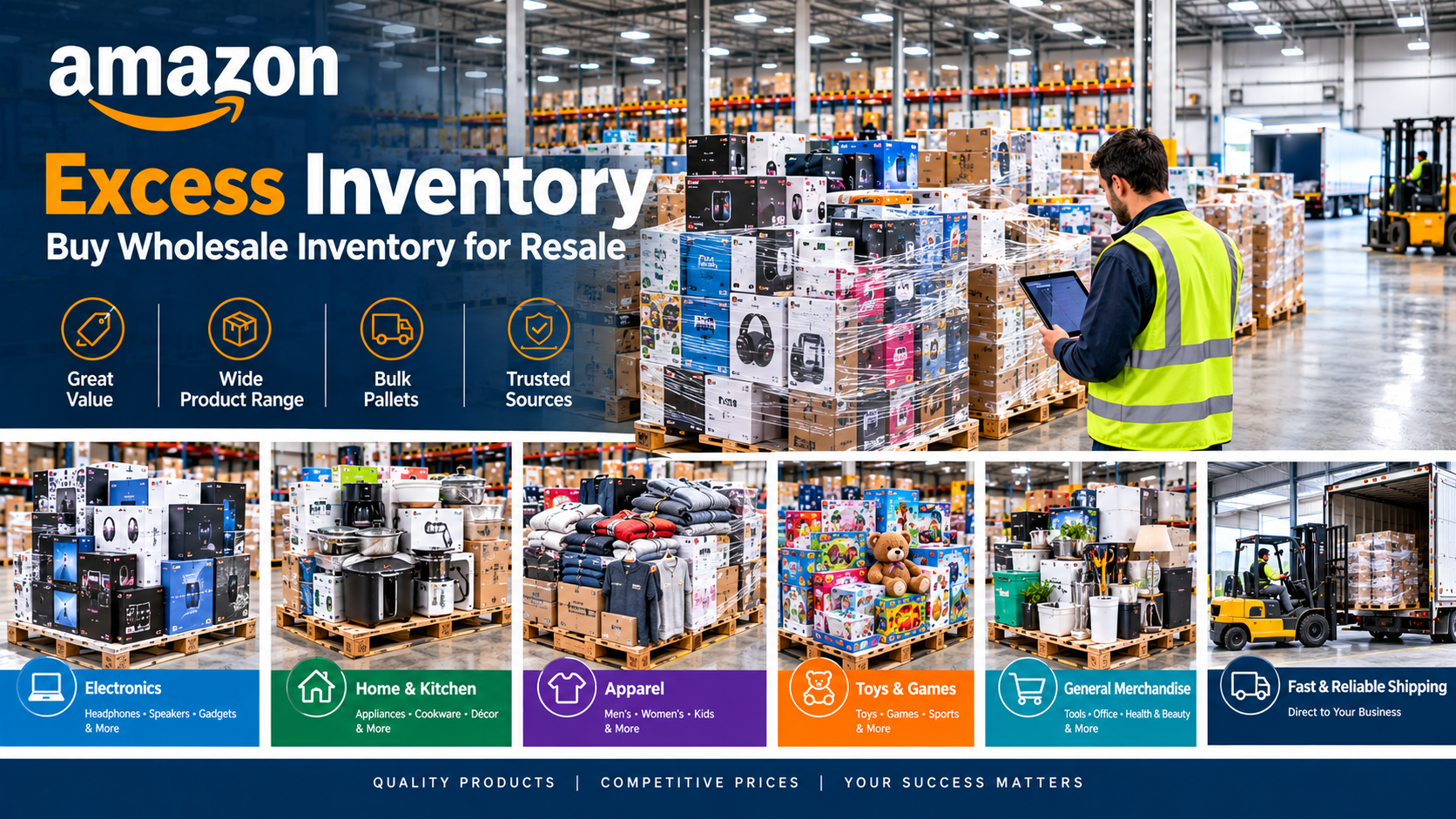
Amazon excess inventory refers to merchandise that Amazon or its selling ecosystem has more of than it currently needs or can efficiently sell through its normal retail channels.
Excess inventory can develop for many reasons. Products may have been over-ordered, demand may have changed, seasonal merchandise may no longer be needed, or Amazon may need to clear warehouse capacity for newer products.
For liquidation buyers, this creates an opportunity to purchase merchandise in bulk at prices below conventional wholesale or retail levels.
Excess inventory can include:
- Consumer electronics
- Home and kitchen products
- Apparel and footwear
- Toys and games
- Beauty and personal care products
- Tools and hardware
- Office products
- General merchandise
- Seasonal products
- Mixed-category inventory
The important point is that
. Some liquidation lots may contain new or overstock merchandise, while other lots can contain customer returns, warehouse-damaged products, or mixed-condition goods.
Amazon’s official U.S. liquidation marketplace is operated through B-Stock and provides qualified business buyers with access to liquidation inventory. Its listed inventory can include overstock, customer returns, and warehouse-damaged merchandise.
Why Does Amazon Have Excess Inventory?
Large retailers constantly move enormous quantities of merchandise through fulfillment centers and distribution networks.
Even with sophisticated forecasting, inventory levels can become higher than expected.
Common causes include:
1. Overstock
A product may have been purchased or stocked in quantities greater than current demand.
For example, a retailer might have expected a particular kitchen appliance to sell quickly but discover that sales slowed after the initial launch.
The remaining units become excess inventory.
2. Seasonal Demand
Holiday decorations, outdoor equipment, winter clothing, toys, and other seasonal products have limited selling windows.
Once demand decreases, retailers have an incentive to move the remaining merchandise rather than keep warehouse space occupied.
3. Changing Consumer Demand
Consumer preferences can change quickly.
Electronics, accessories, fashion products, and home goods can lose demand when newer products enter the market.
4. Warehouse Capacity
Warehouse space has economic value.
Liquidating slower-moving merchandise can free storage capacity for products with stronger demand.
5. Product Assortment Changes
Retailers regularly adjust their product selections.
When a particular product is removed from an assortment, remaining inventory may eventually enter a liquidation channel.
Amazon Excess Inventory vs. Overstock vs. Returns
These terms are often used interchangeably, but they are not necessarily identical.
Amazon Excess Inventory
This is the broadest term. It describes inventory that is surplus to current requirements and may include different sources and conditions.
Amazon Overstock Inventory
Overstock generally refers to merchandise that exceeds current demand or stocking requirements.
Overstock can be particularly attractive to resellers because products may be new or otherwise in better condition than customer-return merchandise.
Amazon Return Inventory
Customer returns are products that have been purchased and subsequently returned.
Their condition can vary significantly.
A returned item might be:
- Unopened
- Like new
- Open-box
- Used
- Missing accessories
- Damaged
- Non-functional
Amazon Warehouse-Damaged Inventory
Warehouse-damaged products can have packaging or merchandise damage resulting from handling or storage.
The exact condition of any liquidation lot should always be evaluated from its listing information rather than assumed from the word “excess.”
Where Can You Buy Amazon Excess Inventory?
One of the most important considerations is where the inventory originates.
The official Amazon U.S. Liquidation Auctions storefront on B-Stock is Amazon’s B2B liquidation marketplace for qualified U.S.-based business buyers.
Amazon Liquidation Auctions on B-Stock
B-Stock also operates marketplaces where businesses can purchase returned, overstock, and other excess merchandise from retailers and manufacturers. Available purchasing formats can include auctions, Buy Now listings, and Make an Offer transactions, depending on the marketplace.
For buyers, this distinction matters because liquidation sourcing is not the same as buying ordinary wholesale inventory.
You should understand:
- Who is selling the merchandise
- Where it is shipping from
- What condition it is in
- Whether a manifest is provided
- How shipping is calculated
- Whether shortages are possible
- What the marketplace’s terms say about winning bids and claims
Amazon Excess Inventory Pallets
One of the most common ways to purchase liquidation merchandise is by the pallet.
Instead of purchasing individual products, a reseller purchases a lot containing multiple units.
A pallet might contain:
- 50+ individual products
- Hundreds of units
- A single product category
- Multiple brands
- Mixed categories
- A combination of different conditions
The number of units, pallets, retail value, weight, and product mix can vary dramatically between lots.
That is why experienced liquidation buyers evaluate each individual listing instead of assuming that every pallet is a bargain.
What Products Are Found in Amazon Excess Inventory?
Amazon excess inventory can cover a remarkably broad range of categories.
Electronics
Electronics are one of the most attractive categories for many liquidation resellers because individual products can have relatively high resale values.
Possible products include:
- Headphones
- Speakers
- Computer accessories
- Tablets
- Smart devices
- Cameras
- Gaming accessories
- Chargers
- Small electronics
- Home technology
Electronics can also carry higher testing and warranty risks, so a buyer should never value every unit as if it were guaranteed working.
Home and Kitchen
Home and kitchen inventory is another major liquidation category.
Examples include:
- Small appliances
- Cookware
- Kitchen accessories
- Storage products
- Furniture
- Lighting
- Bedding
- Home décor
- Cleaning equipment
These products can work especially well for local resale because larger items can be expensive to ship individually.
Apparel and Footwear
Clothing liquidation can include:
- Shirts
- Jackets
- Pants
- Shoes
- Children’s clothing
- Seasonal apparel
- Accessories
The challenge is that apparel requires careful attention to size, style, brand, season, and current demand.
A pallet with a high number of units is not necessarily profitable if the assortment consists primarily of difficult-to-sell sizes or outdated styles.
Toys and General Merchandise
General merchandise can include products from many different consumer categories.
Examples include:
- Toys
- Games
- Sporting goods
- Pet products
- Office supplies
- Tools
- Household accessories
- Seasonal merchandise
Mixed-category lots can provide product variety, but they also require more work to sort, photograph, price, and list.
How to Evaluate Amazon Excess Inventory
Never evaluate a liquidation pallet based only on its advertised retail value.
Instead, analyze the realistic resale value.
A useful process is:
Step 1: Review the Manifest
If a manifest is available, identify:
- Product names
- SKUs
- Quantities
- Retail values
- Condition information
- Brands
- Product categories
A manifest gives you a starting point for estimating what the lot contains.
Step 2: Verify Product Demand
Search the individual products across the marketplaces where you intend to sell.
Look at actual selling prices rather than simply looking at active listings.
Step 3: Estimate Realistic Revenue
Do not assume you will sell every product for full retail price.
Instead, estimate a realistic selling price based on:
- Condition
- Competition
- Product demand
- Brand
- Seasonality
- Marketplace fees
- Shipping
- Time required to sell
Step 4: Estimate Unsellable Inventory
Some liquidation inventory may require:
- Testing
- Cleaning
- Repair
- Parts
- Recycling
- Discounting
- Bundling
Build this into your financial model.
How to Read an Amazon Excess Inventory Manifest
The manifest is one of the most valuable tools available to a liquidation buyer.
A basic manifest might provide information such as:
| Information | Why It Matters |
|---|---|
| Product description | Identifies what you are buying |
| Quantity | Determines inventory volume |
| SKU | Helps research individual products |
| Condition | Influences resale value |
| Retail value | Provides a reference point |
| Category | Helps determine your target customers |
| Estimated weight | Helps assess logistics |
However, retail value is not the same as profit.
If a pallet has an advertised retail value of $10,000, that does not mean you can automatically sell the merchandise for $10,000.
Your actual revenue could be considerably lower after discounts, marketplace fees, defective units, missing accessories, shipping, and other expenses.
How Much Does Amazon Excess Inventory Cost?
There is no single price for Amazon excess inventory.
Pricing depends on:
- Product category
- Quantity
- Condition
- Retail value
- Current demand
- Seller competition
- Location
- Shipping cost
- Auction activity
- Lot size
Some liquidation listings are sold through auctions, while other B-Stock marketplaces can offer different purchasing formats.
For auction purchases, the winning bid should never be considered the total cost.
Your actual acquisition cost is closer to:
Purchase Price + Shipping + Fees + Processing Costs = Landed Cost
That landed cost is the number that should be compared against your expected resale revenue.
How to Calculate Your Maximum Bid
A simple liquidation purchasing formula is:
Maximum Bid = Expected Resale Revenue − Shipping − Fees − Processing Costs − Desired Profit
For example, imagine you estimate that a pallet can realistically generate:
$4,000 in resale revenue
You estimate:
- Shipping: $500
- Marketplace fees: $600
- Repairs and preparation: $250
- Other costs: $150
- Desired profit: $1,000
Your maximum purchase price would be:
$4,000 − $500 − $600 − $250 − $150 − $1,000 = $1,500
In this example, paying significantly more than $1,500 could make the deal unattractive.
The exact numbers will vary, but the principle is important:
Bid based on realistic resale economics, not the advertised retail value.
Why Landed Cost Matters
A liquidation pallet can look inexpensive until freight is added.
Amazon’s U.S. liquidation shipping information states that standard orders use automatically generated shipping costs and that buyers cannot arrange their own carrier or pick up the merchandise themselves. Standard orders can also take up to 28 days after payment to ship.
The official shipping information also notes that pallet counts and shipment weights displayed on auction pages are estimates. LTL freight is commonly used for palletized shipments.
This means you should calculate shipping before placing a bid.
Do not wait until after winning an auction to discover that freight makes the deal unprofitable.
Receiving Amazon Excess Inventory
Receiving liquidation pallets requires preparation.
For larger shipments, you may need:
- Loading dock
- Forklift
- Pallet jack
- Warehouse space
- Receiving staff
- Sorting tables
- Storage racks
Amazon’s shipping guidance states that buyers are responsible for unloading trucks and recommends having a loading dock or forklift available. Liftgate and unloading-related fees may apply depending on the shipment.
If you operate from a residential location, verify delivery requirements before buying.
A pallet is not useful if you have no practical way to unload it.
What Happens If Inventory Is Missing?
This is an important consideration when buying Amazon liquidation inventory.
According to Amazon’s official liquidation information, standard auction inventory may experience shortages because some inventory can remain available for retail sale while an auction is active. When the order is prepared, Amazon provides an adjusted manifest reflecting what is actually shipped.
If inventory is missing, Amazon provides adjustment credits according to its stated process.
If a substantial portion of an order cannot be fulfilled, the order may be canceled.
This is one reason buyers should carefully understand the marketplace’s current terms and adjustment policies before bidding.
B-Stock Blue and Amazon Excess Inventory
Some Amazon listings are identified as B-Stock Blue, a program designed to provide optimized fulfillment and faster shipping.
According to B-Stock’s current shipping information, B-Stock Blue inventory comes from a centralized processing center and includes third-party verified manifests, inventory verification, shipment tracking, and reduced shortage risk. B-Stock says these orders typically ship within three business days of payment, subject to delivery scheduling.
For buyers who value predictable fulfillment, these characteristics can be worth considering when comparing listings.
How to Make Money With Amazon Excess Inventory
Buying cheap inventory is only the first step.
The real business opportunity comes from efficiently turning inventory into cash.
Sell on Online Marketplaces
Individual products can potentially be sold through:
- eBay
- Amazon, where permitted
- Walmart Marketplace
- Facebook Marketplace
- Other specialized marketplaces
Each marketplace has different fees, policies, customer expectations, and shipping requirements.
Sell Locally
Local sales can be particularly useful for:
- Furniture
- Appliances
- Large home goods
- Bulk lots
- Tools
- General merchandise
Local selling can reduce shipping expenses and allow you to move larger products quickly.
Create Product Bundles
Instead of selling every item individually, complementary products can sometimes be bundled.
For example:
Kitchen appliance + accessories + storage products = kitchen starter bundle
Bundles can reduce listing work and help move lower-value merchandise.
Sell in Bulk to Other Resellers
You do not necessarily need to sell every item to the final consumer.
Other liquidation buyers, flea-market vendors, online sellers, and local retailers may purchase smaller wholesale lots from you.
This can provide a faster inventory turnover strategy.
How to Improve Your Amazon Excess Inventory Profit Margin
Profitability is often determined by what happens after the pallet arrives.
Consider building a repeatable workflow:
1. Receive
Record every pallet and shipment.
2. Sort
Separate products by category and condition.
3. Test
Test electronics and other functional products before listing them as working.
4. Clean
Clean merchandise and packaging where appropriate.
5. Photograph
Use consistent product photography.
6. Price
Set prices based on current market conditions.
7. List
Create optimized listings with accurate descriptions.
8. Track
Monitor sell-through rates.
9. Discount
Move stagnant inventory instead of allowing it to consume valuable storage space.
10. Reinvest
Use profits from successful categories to purchase additional inventory.
Common Amazon Excess Inventory Buying Mistakes
Mistake 1: Treating Retail Value as Profit
Retail value is a reference point—not guaranteed revenue.
Mistake 2: Ignoring Freight
A cheap pallet with expensive freight may be a bad deal.
Mistake 3: Assuming Everything Is New
Always review the listed inventory condition.
Mistake 4: Buying Products You Cannot Sell
Research demand before bidding.
Mistake 5: Overbidding
Auction competition can cause buyers to pay more than the economics justify.
Mistake 6: Ignoring Labor
Sorting, testing, photographing, listing, packing, and customer service all have costs.
Mistake 7: Buying Too Much Too Quickly
New liquidation buyers often purchase more inventory than they can process.
Start with manageable lot sizes and develop a repeatable system.
Amazon Excess Inventory Buying Checklist
Before purchasing, ask:
-
Who is selling the inventory?
-
Is the listing from a reputable liquidation marketplace?
-
What is the inventory condition?
-
Is a manifest available?
-
How many units are included?
-
What products are actually listed?
-
What are realistic resale prices?
-
What percentage might be unsellable?
-
How much will shipping cost?
-
What is my landed cost?
-
What are my marketplace fees?
-
How much labor will processing require?
-
Where will I sell the inventory?
-
How quickly can I turn it into cash?
-
What is my maximum bid?
-
Do I have enough warehouse and receiving capacity?
If you cannot answer these questions, you probably should not bid yet.
Is Amazon Excess Inventory Worth Buying?
Amazon excess inventory can be profitable, but profitability depends on disciplined purchasing and efficient resale.
The best opportunities are not necessarily the pallets with the highest advertised retail value.
Instead, look for lots where:
- You understand the products
- Demand is strong
- The condition is manageable
- Shipping is reasonable
- The manifest is useful
- You have established resale channels
- Your maximum bid leaves sufficient profit margin
Liquidation is fundamentally a numbers business.
The goal is not simply to buy merchandise cheaply.
The goal is to buy inventory at a price that leaves enough room for shipping, labor, fees, losses, and profit.