How to Find a Liquidation Warehouse Near Me
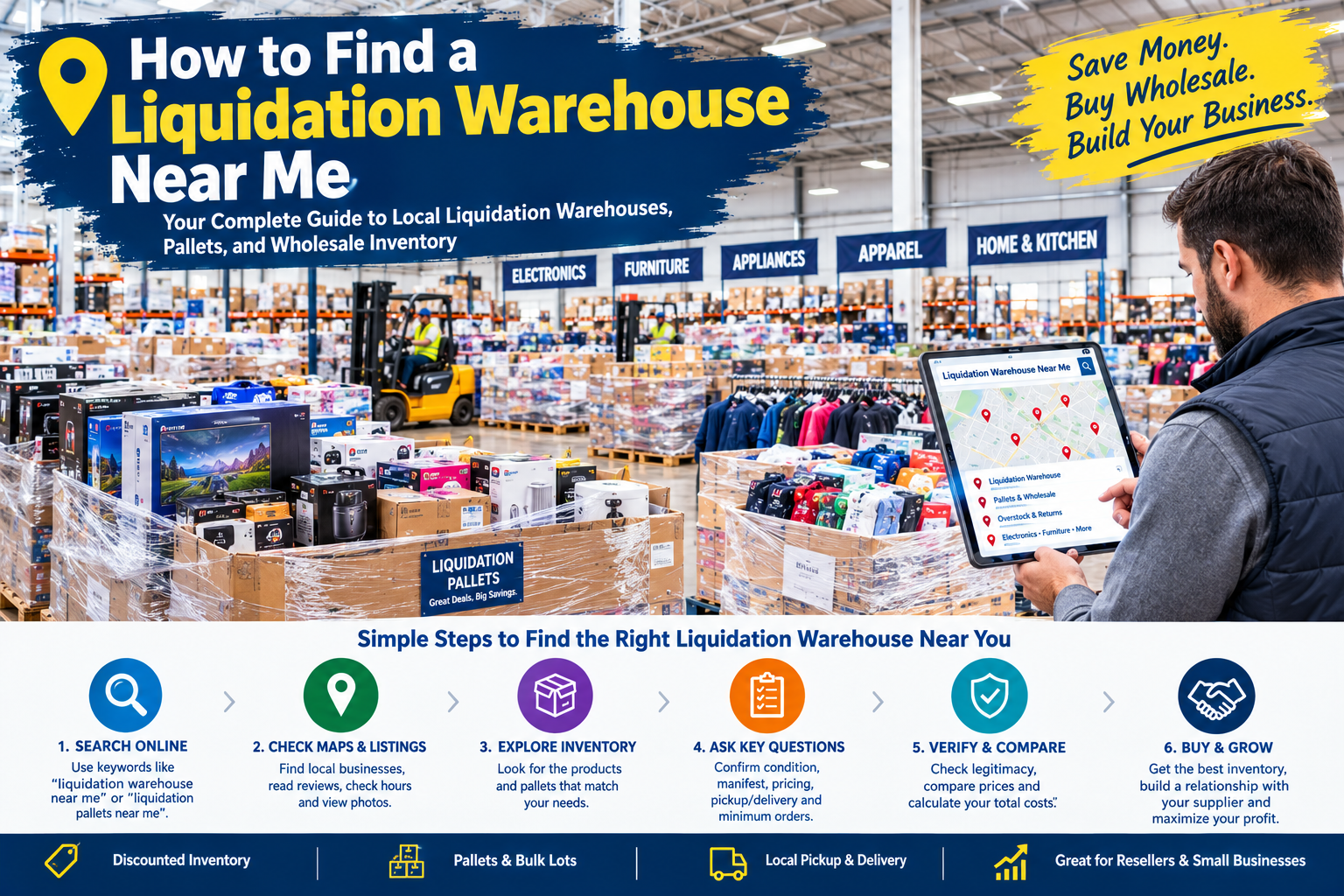
The easiest way to find local liquidation warehouses is to combine online searches, map listings, social media, business directories, and direct supplier research.
Rather than searching for only one phrase, use several variations based on the merchandise you want.
Useful searches include:
- liquidation warehouse near me
- liquidation warehouses near me
- wholesale liquidation warehouse near me
- liquidation pallets near me
- Amazon liquidation warehouse near me
- Amazon return warehouse near me
- Amazon return pallets near me
- overstock warehouse near me
- surplus warehouse near me
- return pallets near me
- wholesale pallets near me
- liquidation inventory near me
- liquidation merchandise near me
- discount warehouse near me
- pallet liquidation warehouse near me
You can also add your city, ZIP code, neighborhood, or region to make the search more specific.
For example, instead of searching only for liquidation warehouse near me, you might search for:
“liquidation pallets in [your city]”
or
“wholesale liquidation warehouse in [your city]”.
This can help you identify businesses that specialize in the type of inventory you’re actually looking for.
1. Use Google Maps to Find Local Liquidation Warehouses
Google Maps is one of the most useful tools for finding physical liquidation businesses.
Search for terms such as:
“liquidation warehouse”
“liquidation pallets”
“surplus store”
“wholesale warehouse”
“closeout warehouse”
“overstock store”
Look at several businesses rather than automatically choosing the first result.
Check the listing for:
- Business location
- Telephone number
- Opening hours
- Customer reviews
- Customer photographs
- Website
- Social media accounts
- Product descriptions
- Pickup information
Photos can be particularly useful because they may show whether the business actually operates from a warehouse or simply uses generic stock photographs.
Before traveling to the location, contact the business and confirm that it currently sells liquidation inventory to the public or to your type of buyer.
2. Search for the Type of Inventory You Want
One of the biggest mistakes buyers make is searching for a liquidation warehouse without deciding what they actually want to purchase.
A better strategy is to search according to your resale category.
Electronics
Search for:
electronics liquidation warehouse near me
Potential inventory can include televisions, computers, accessories, small electronics, networking equipment, and other consumer products.
Furniture
Search for:
furniture liquidation warehouse near me
This can help locate warehouses handling returned furniture, showroom merchandise, office furniture, home furnishings, and closeout products.
Amazon Returns
Search for:
Amazon return pallets near me
or
Amazon liquidation warehouse near me
Be careful with businesses using the Amazon name. A company claiming to sell Amazon returns should be evaluated carefully, and buyers should verify exactly where its merchandise comes from.
Apparel
Search for:
clothing liquidation warehouse near me
This can uncover suppliers selling clothing, shoes, accessories, seasonal apparel, and mixed fashion inventory.
General Merchandise
For mixed inventory, search for:
mixed liquidation pallets near me
This can produce suppliers selling pallets containing multiple product categories.
3. Look for Liquidation Pallets Near Me
Many liquidation warehouses sell inventory in pallet quantities.
A liquidation pallet is generally a group of products assembled and sold together rather than individually.
A pallet might contain:
- Electronics
- Home goods
- Kitchen products
- Tools
- Toys
- Apparel
- Beauty products
- Furniture
- Appliances
- General merchandise
The contents can vary considerably.
Some pallets are highly organized and accompanied by a manifest. Others are mixed, partially manifested, or sold with limited information.
If you are buying for resale, a manifest can make it easier to estimate potential revenue before purchasing.
However, a manifest should never be treated as a guarantee of profit.
4. Determine Where the Inventory Comes From
Before buying, ask the warehouse where its merchandise originates.
Possible sources include:
- Retailers
- Manufacturers
- Distributors
- Customer returns
- Store closures
- Overstock programs
- Business liquidations
- Shelf pulls
- Excess inventory
Knowing the source can help you understand the likely condition and composition of the merchandise.
For example, a pallet of retail overstock may have a different risk profile from a pallet consisting primarily of customer returns.
The words “liquidation” and “discount” do not automatically mean that every product is new or fully functional.
Always ask about condition.
5. Understand Liquidation Inventory Conditions
Condition is one of the most important factors when buying liquidation merchandise.
A warehouse may classify products as:
New
Products are generally unused and may still have original packaging.
Overstock
Products that were not sold through the original retail channel.
Customer Returns
Products previously purchased and returned by customers.
Open Box
Products with opened packaging that may or may not have been used.
Shelf Pulls
Merchandise removed from retail shelves.
Salvage or Damaged
Products that may require repair, parts, recycling, or additional processing.
The exact definitions vary by supplier, so ask the warehouse to explain its condition categories.
6. Ask Whether the Pallet Has a Manifest
A liquidation manifest is a list describing the products included in a lot or pallet.
A useful manifest may include information such as:
- Product description
- Brand
- Quantity
- Model number
- Retail value
- Condition
- SKU
- Estimated value
A manifest can make the buying process much easier because you can research individual products and estimate realistic resale prices.
But don’t make the common mistake of adding up suggested retail prices and assuming that amount represents your profit.
Retail value is not the same as resale revenue.
A product with a $100 original retail price may realistically sell for considerably less in the secondary market.
7. Research Actual Resale Prices
Before purchasing a pallet, research what comparable products actually sell for.
Look at completed sales and current marketplace competition where possible.
Consider:
- Product condition
- Brand
- Model
- Age
- Demand
- Competition
- Shipping costs
- Marketplace fees
- Return rates
- Seasonal demand
For example, suppose a pallet contains products with an estimated retail value of $5,000.
That does not necessarily mean you can sell everything for $5,000.
Your realistic resale revenue might be significantly lower.
This is why experienced liquidation buyers calculate profitability using realistic resale prices rather than advertised retail value.
8. Calculate Your Maximum Purchase Price
Before bidding or buying, establish the maximum amount you are willing to pay.
A useful formula is:
Maximum Purchase Price = Expected Resale Revenue − All Other Costs − Desired Profit
For example:
Expected resale revenue: $5,000
Transportation: $500
Marketplace and selling fees: $700
Repairs and preparation: $300
Packaging: $150
Expected losses: $250
Desired profit: $1,200
Maximum purchase price:
$5,000 − $500 − $700 − $300 − $150 − $250 − $1,200 = $1,900
In this example, paying more than approximately $1,900 would reduce the target profit.
The exact numbers will vary depending on your business model.
9. Consider the Full Landed Cost
The price printed on the pallet is only one part of the cost.
Your actual landed cost can include:
Landed Cost = Purchase Price + Transportation + Processing Costs + Other Expenses
Additional expenses may include:
- Freight
- Fuel
- Pickup fees
- Storage
- Labor
- Cleaning
- Testing
- Repairs
- Replacement parts
- Packaging
- Marketplace fees
- Returns
- Unsellable merchandise
This is especially important when comparing a local warehouse with an online liquidation marketplace.
A pallet that costs slightly more locally could potentially be a better deal if you avoid expensive freight.
10. Ask Whether You Can Inspect the Inventory
One major advantage of buying locally is the possibility of inspecting merchandise before purchasing.
Ask whether the warehouse allows customers to:
- Inspect pallets
- Open boxes
- Test electronics
- Examine packaging
- Check product quantities
- Photograph inventory
- Review manifests
Not every warehouse permits inspection, so confirm its policy before visiting.
If inspection is allowed, pay attention to damaged boxes, missing parts, visible wear, broken products, and signs of moisture or improper storage.
11. Compare Liquidation Warehouses Before Buying
Don’t assume the first warehouse you discover is the best supplier.
Create a simple comparison between several suppliers.
| Factor | Warehouse A | Warehouse B | Warehouse C |
|---|---|---|---|
| Pallet price | $ | $ | $ |
| Manifest available | Yes/No | Yes/No | Yes/No |
| Inspection allowed | Yes/No | Yes/No | Yes/No |
| Main categories | — | — | — |
| Pickup available | Yes/No | Yes/No | Yes/No |
| Delivery available | Yes/No | Yes/No | Yes/No |
| Condition | — | — | — |
| Minimum order | — | — | — |
This makes it easier to compare suppliers based on the factors that actually affect profitability.
12. Local Pickup vs. Delivery
A local liquidation warehouse may offer pickup, delivery, or both.
Local Pickup
Pickup can reduce freight expenses and give you an opportunity to inspect the merchandise before loading it.
However, make sure you have an appropriate vehicle and enough space to transport the pallet safely.
Delivery
Delivery may be more convenient, particularly for larger purchases.
Ask whether the quoted price includes:
- Freight
- Residential delivery
- Liftgate service
- Unloading
- Inside delivery
- Fuel surcharges
A low pallet price can become much more expensive after delivery and handling fees.
13. Ask About Minimum Orders
Some liquidation suppliers sell single pallets.
Others may require:
- Multiple pallets
- Case quantities
- Minimum dollar amounts
- Half-truck purchases
- Full truckloads
If you are new to liquidation, starting with a smaller purchase can reduce your exposure while you learn how the supplier’s inventory performs.
Once you understand the quality and resale potential, you can consider increasing your order size.
14. Verify the Liquidation Warehouse Is Legitimate
Unfortunately, liquidation scams exist, particularly online.
Before sending payment, verify the business.
Look for:
- A real physical address
- Consistent business information
- Independent reviews
- Working telephone number
- Established online presence
- Clear terms and conditions
- Real warehouse photographs
- Transparent inventory descriptions
- Reasonable payment methods
Be cautious if a seller:
- Demands immediate payment
- Uses only messaging apps
- Refuses to provide an address
- Offers deals far below market value
- Uses copied photographs
- Has no verifiable business history
- Refuses to explain the inventory source
If something appears too good to be true, investigate before paying.
15. Build a Relationship With Local Suppliers
Once you find a reliable
, building a relationship can become more valuable than constantly searching for new suppliers.
Ask the warehouse whether it can notify you when certain categories arrive.
For example, you may specialize in:
- Electronics
- Tools
- Home improvement
- Furniture
- Apparel
- Toys
- Kitchen products
A supplier that understands your buying criteria may be able to direct you toward inventory that better matches your business.
Repeat customers may also become familiar with the warehouse’s inventory cycles and buying process.
Liquidation Warehouse vs. Liquidation Store
The terms are sometimes used interchangeably, but they often target different buying experiences.
A liquidation store typically focuses on consumer shopping. Merchandise may be arranged on shelves, tables, bins, or displays, and products can often be purchased individually.
A liquidation warehouse is more likely to handle inventory in bulk.
Warehouses may sell:
- Pallets
- Cases
- Bulk lots
- Truckloads
- Wholesale inventory
If you are searching for inexpensive individual products, a liquidation store may be more appropriate.
If you’re buying inventory for resale, a liquidation warehouse near me may be the better search.
What Can You Buy From a Liquidation Warehouse?
Inventory varies from supplier to supplier, but common categories include:
Electronics
- TVs
- Computers
- Tablets
- Accessories
- Audio equipment
- Smart-home products
Home and Kitchen
- Small appliances
- Cookware
- Storage products
- Household goods
- Décor
Furniture
- Office furniture
- Bedroom furniture
- Home furnishings
- Outdoor furniture
Apparel
- Clothing
- Shoes
- Bags
- Accessories
General Merchandise
- Toys
- Tools
- Sporting goods
- Seasonal products
- Consumer goods
Always confirm the actual inventory mix before purchasing.
How to Buy Your First Liquidation Pallet
If you are new to liquidation, keep your first purchase simple.
Step 1: Choose a product category
Pick a category you understand.
Step 2: Find several local suppliers
Don’t rely on a single warehouse.
Step 3: Compare inventory and prices
Look beyond the advertised pallet price.
Step 4: Review the manifest
Research products individually where possible.
Step 5: Estimate realistic resale revenue
Don’t rely solely on MSRP or estimated retail value.
Step 6: Calculate your maximum purchase price
Set your number before negotiating or bidding.
Step 7: Inspect the merchandise
If inspection is permitted, take advantage of it.
Step 8: Plan transportation
Know exactly how the inventory will get to your storage location.
Step 9: Track your results
Record sales, fees, repairs, losses, and profit.
Step 10: Refine your buying strategy
Use your first purchase to determine which categories and suppliers work best.
Common Mistakes When Buying From a Liquidation Warehouse
Buying Based on Retail Value
A pallet advertised with $10,000 in retail value is not necessarily worth $10,000.
Your business needs to generate realistic resale revenue.
Ignoring Condition
Returns and open-box merchandise can require testing, cleaning, repair, or replacement parts.
Forgetting Transportation
A cheap pallet can become expensive once freight and handling are included.
Buying Too Much Too Soon
New buyers should avoid committing large amounts of capital before understanding the supplier.
Ignoring Storage
Pallet inventory takes space. Furniture and large appliances can consume substantial storage capacity.
Failing to Research Demand
A product can be inexpensive and still be difficult to sell.
Not Tracking Profit
Record your actual purchase price, expenses, sales, and losses. This information becomes extremely valuable for future buying decisions.