Return Pallets Near Me: Where to Buy Liquidation Return Pallets
If you’re searching for return pallets near me, you’re probably looking for a reliable way to buy customer returns, overstock, excess inventory, or liquidation merchandise at below-retail prices.
Return pallets can contain electronics, home goods, tools, appliances, furniture, apparel, toys, beauty products, and thousands of other items. For resellers, the appeal is straightforward: purchase merchandise in bulk, sort and evaluate the inventory, then resell individual products through online marketplaces, local stores, flea markets, social media, or other sales channels.
However, buying return pallets isn’t simply about finding the lowest price. The condition of the products, source of the inventory, transportation costs, manifest accuracy, resale demand, and percentage of unsellable merchandise can dramatically affect profitability.
This guide explains where to find return pallets near you, how return pallets work, what they cost, how to evaluate them, and how to avoid common liquidation buying mistakes.
What Are Return Pallets?
Return pallets are bulk lots of merchandise that has been returned to a retailer, manufacturer, distributor, marketplace, or other seller.
Instead of returning every item to regular retail inventory, businesses may consolidate returned merchandise and sell it through liquidation channels.
A pallet can contain products that are:
- Customer returns
- Open-box merchandise
- Overstock
- Shelf pulls
- Excess inventory
- Discontinued products
- Damaged packaging
- Tested and working products
- Untested merchandise
- Products requiring repair
The exact contents depend on the supplier and liquidation program.
This is why understanding the
is just as important as its purchase price.
How to Find Return Pallets Near Me
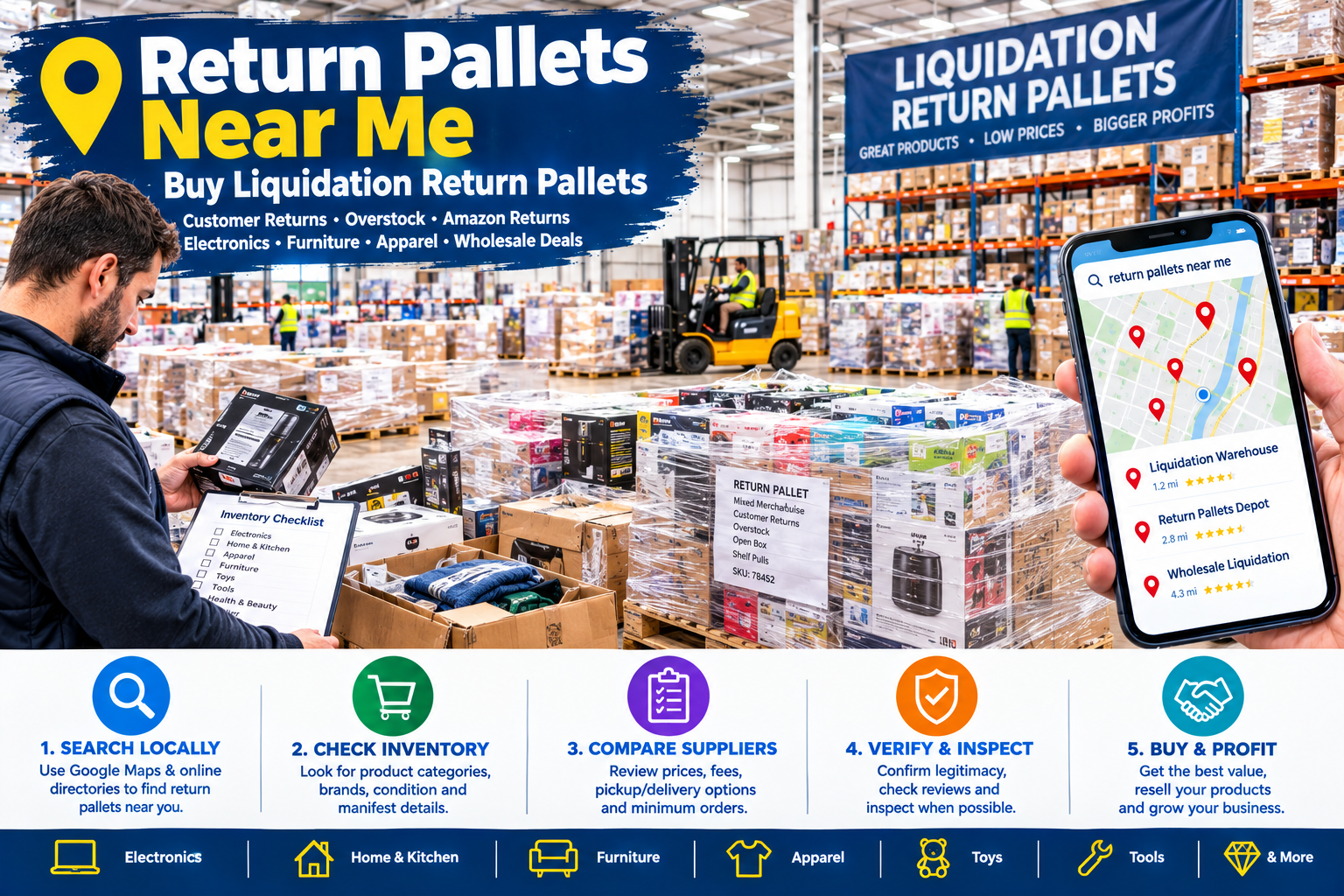
The easiest way to find local return pallets is to combine search engines, map listings, liquidation marketplaces, wholesale suppliers, and local business directories.
Start with searches such as:
- return pallets near me
- Amazon return pallets near me
- customer return pallets near me
- liquidation pallets near me
- retail return pallets near me
- wholesale return pallets near me
- return liquidation pallets near me
- electronics return pallets near me
- mixed return pallets near me
- return pallets for sale near me
You can make the search even more specific by adding your city or ZIP code.
For example:
“return pallets in [city]”
or
“liquidation return pallets in [city]”.
This can help you locate suppliers that offer local pickup instead of requiring long-distance freight.
Where Can I Buy Return Pallets Near Me?
There are several places where return pallets may be available.
1. Local Liquidation Warehouses
Local liquidation warehouses are one of the most convenient options because you may be able to inspect inventory and avoid some long-distance transportation costs.
Depending on the warehouse, you may find:
- Customer returns
- Overstock
- Store liquidation inventory
- Electronics
- Furniture
- Appliances
- Apparel
- General merchandise
Some warehouses sell individual pallets, while others require larger purchases.
Always contact the warehouse before visiting to confirm inventory availability.
2. Liquidation Stores
Some liquidation stores sell merchandise that originated from customer returns and overstock inventory.
Unlike warehouses, liquidation stores often sell individual products rather than entire pallets.
However, some may also offer bulk purchasing opportunities for resellers.
If your goal is to buy individual products, a liquidation store may be more suitable.
If you’re looking to purchase inventory in bulk, search specifically for return pallets near me or wholesale liquidation warehouses near me.
3. Online Liquidation Marketplaces
Online liquidation marketplaces can connect retailers and brands with business buyers interested in returned, excess, and liquidation inventory.
One example is B-Stock, which operates liquidation marketplaces for major retailers and brands.
For example, Amazon’s official U.S. liquidation storefront on B-Stock sells inventory to qualified business buyers. Its inventory can include customer returns, overstock, and warehouse-damaged merchandise.
This type of marketplace can be useful when a local warehouse doesn’t have the category or volume you need.
Amazon Return Pallets Near Me
“Amazon return pallets” is one of the most searched categories in liquidation.
However, buyers should be careful when evaluating businesses that advertise themselves as selling Amazon returns.
Amazon’s official U.S. liquidation marketplace operates through B-Stock and requires qualified U.S.-based business buyers. The marketplace states that inventory can include customer returns, overstock, and warehouse-damaged merchandise.
That doesn’t mean every local company advertising Amazon return pallets is directly affiliated with Amazon.
Before purchasing, ask:
- Where did the inventory come from?
- Is the supplier authorized to sell the merchandise?
- Is the pallet manifested?
- What condition are the products?
- Can you inspect the pallet?
- What happens if products are missing?
- Are there additional fees?
This distinction is important because the phrase “Amazon returns” is widely used in the secondary liquidation market.
What Can You Find in Return Pallets?
Return pallets can contain almost any type of consumer merchandise.
Electronics Return Pallets
Electronics can include:
- Televisions
- Computers
- Tablets
- Headphones
- Speakers
- Accessories
- Smart-home devices
- Gaming products
Electronics can have attractive resale potential, but testing is particularly important.
A returned electronic product may be fully functional, partially functional, missing accessories, locked to an account, cosmetically damaged, or completely defective.
Home and Kitchen Returns
These pallets can include:
- Small appliances
- Cookware
- Kitchen accessories
- Storage products
- Household goods
- Home décor
Home products can be easier to sell locally because many items don’t require complicated shipping.
Furniture Return Pallets
Furniture liquidation inventory may include:
- Tables
- Chairs
- Shelving
- Desks
- Outdoor furniture
- Bedroom furniture
- Home décor
Large furniture can be profitable but requires adequate storage and transportation.
Apparel Return Pallets
Apparel pallets can contain:
- Shirts
- Pants
- Jackets
- Shoes
- Bags
- Accessories
When buying clothing returns, check sizes, styles, seasons, brands, stains, odors, and missing tags.
Return Pallet Conditions Explained
Understanding condition is essential before purchasing.
New
The product is generally unused and may have original packaging.
Open Box
The packaging has been opened, but the item may still be usable.
Customer Return
The item was previously sold and returned by a customer. Condition can vary substantially.
Shelf Pull
The item was removed from retail inventory and may show handling or packaging wear.
Overstock
The product was never sold through the intended retail channel or was removed from regular inventory.
Salvage
Products may be damaged, incomplete, defective, or suitable primarily for parts or recycling.
Never assume that all products in a return pallet are in the same condition.
Should You Buy Manifested Return Pallets?
A manifested pallet comes with a product list describing some or all of the merchandise in the lot.
Depending on the supplier, the manifest may contain:
- Product names
- SKUs
- Quantities
- Product descriptions
- Model numbers
- Retail values
- Condition information
A manifest makes it easier to research inventory before purchasing.
But a manifest isn’t automatically a guarantee that every item will arrive exactly as expected.
Always read the supplier’s terms regarding shortages, substitutions, adjustments, damaged products, and claims.
How Much Do Return Pallets Cost?
There is no universal price for a return pallet.
Prices depend on:
- Product category
- Number of items
- Brand
- Condition
- Estimated resale value
- Location
- Demand
- Source
- Shipping
- Competition
- Pallet size
A pallet of inexpensive household goods may cost far less than a pallet containing premium electronics.
You should also distinguish between retail value and realistic resale value.
A pallet advertised as having $5,000 in retail value doesn’t necessarily mean you can sell the contents for $5,000.
How to Calculate the Value of a Return Pallet
Start by estimating realistic resale revenue.
Suppose a pallet contains 50 products.
After researching comparable sales, you estimate that you can realistically generate:
$3,500 in gross resale revenue
Now estimate your other costs:
- Pallet purchase: $1,200
- Transportation: $250
- Repairs/testing: $200
- Selling fees: $500
- Packaging: $100
- Unsellable inventory: $150
Total cost:
$2,400
Estimated operating profit:
$3,500 − $2,400 = $1,100
This is much more useful than simply looking at an advertised retail value.
Maximum Purchase Price Formula
Before buying a return pallet, establish your maximum purchase price.
Use:
Maximum Purchase Price = Expected Resale Revenue − All Other Costs − Desired Profit
For example:
Expected resale revenue = $3,500
Other costs = $1,200
Desired profit = $800
Maximum purchase price:
$3,500 − $1,200 − $800 = $1,500
This gives you a clear purchasing ceiling.
If the pallet costs more than your maximum purchase price, you should either negotiate a lower price or find another opportunity.
Don’t Forget the Landed Cost
Local buyers sometimes focus too heavily on the pallet price.
Your actual acquisition cost can include:
Landed Cost = Purchase Price + Transportation + Processing + Other Expenses
Other expenses may include:
- Fuel
- Freight
- Labor
- Storage
- Cleaning
- Repairs
- Testing
- Packaging
- Marketplace fees
- Returns
- Disposal
- Replacement parts
A pallet that appears inexpensive can become a poor investment after these costs are included.
Can You Inspect Return Pallets Before Buying?
This depends on the supplier.
Local liquidation warehouses may allow buyers to inspect pallets, while online marketplaces may sell inventory based on the available description and manifest.
If inspection is permitted, check for:
- Broken packaging
- Missing components
- Water damage
- Crushed boxes
- Visible product damage
- Used merchandise
- Expired products
- Missing accessories
- Signs of poor storage
For electronics, ask whether testing is permitted.
Inspection won’t eliminate risk, but it can help you make a more informed purchase.
Local Pickup vs. Shipped Return Pallets
Buying locally can have a major logistical advantage.
Benefits of Local Pickup
You may be able to:
- Inspect inventory
- Avoid long-distance freight
- Pick up the pallet quickly
- Speak directly with the supplier
- Save on shipping
- Build a relationship with the warehouse
However, you’ll need a suitable vehicle and a way to unload the pallet.
Benefits of Shipping
Online liquidation marketplaces can give you access to inventory outside your local market.
This can be useful when:
- Your local supply is limited
- You need a specific product category
- You want larger volumes
- You need access to major retailer liquidation programs
Always calculate shipping before comparing the economics of local and online inventory.
How to Avoid Return Pallet Scams
The popularity of liquidation pallets has also attracted fraudulent sellers.
Before paying, investigate the supplier.
Warning signs include:
- Extremely low prices
- Pressure to pay immediately
- No physical address
- No verifiable business history
- Stock photographs instead of warehouse photos
- Refusal to provide inventory details
- Unusual payment requests
- No terms or conditions
- Unrealistic promises about profit
Be especially cautious with social media advertisements promising expensive electronics pallets for a fraction of their supposed value.
A legitimate liquidation opportunity should still withstand basic verification.
Questions to Ask a Return Pallet Supplier
Before buying, ask:
- Where did the inventory originate?
- What condition are the products?
- Is the pallet manifested?
- Can I inspect it?
- How many units are included?
- What is the purchase price?
- Are there additional fees?
- Is pickup available?
- Is delivery available?
- What happens if items are missing?
- Are defective products expected?
- Is there a minimum purchase?
- Are returns accepted?
- How quickly can the pallet be collected?
- What documentation comes with the purchase?
The answers can help you determine whether the opportunity fits your business.
Best Products for Beginner Resellers
If you’re new to liquidation, consider starting with categories you already understand.
Good starting categories may include:
- Small home goods
- Tools
- Kitchen products
- Consumer accessories
- Clothing
- Toys
- Small appliances
Large furniture and complex electronics can require more storage, testing, transportation, and repair knowledge.
The best category depends on your market and sales channels.
Where Can You Sell Products From Return Pallets?
After purchasing and processing your inventory, you can sell products through multiple channels.
Potential options include:
Online Marketplaces
Useful for products with established search demand.
Social Media
Facebook Marketplace and other social selling channels can work well for local transactions.
Your Own Website
A website gives you more control over branding and customer relationships.
Flea Markets
Useful for lower-priced general merchandise and impulse purchases.
Local Stores
Some resellers supply independent shops with discounted merchandise.
Pop-Up Sales
Temporary sales events can be effective for moving mixed inventory.
Your ideal sales channel depends on the category, product value, shipping requirements, and local demand.
How to Make Money With Return Pallets
Successful liquidation reselling is less about finding a “secret pallet” and more about buying correctly.
A strong process looks like this:
Find inventory → Research products → Calculate resale value → Set maximum price → Purchase → Inspect → Process → List → Sell → Track results
Track your actual performance after every pallet.
Record:
- Purchase price
- Transportation
- Number of sellable items
- Number of damaged items
- Revenue
- Selling fees
- Repair costs
- Storage
- Net profit
After several purchases, you’ll have your own data showing which categories and suppliers work best.
Return Pallets Near Me: Buying Checklist
Before purchasing your next pallet, use this checklist:
-
Supplier verified
-
Physical location confirmed
-
Inventory source understood
-
Product condition confirmed
-
Manifest reviewed
-
Resale prices researched
-
Transportation cost calculated
-
Processing costs estimated
-
Selling fees included
-
Potential losses included
-
Maximum purchase price established
-
Storage space available
-
Sales channel prepared
-
Supplier terms reviewed
If several of these boxes remain unchecked, gather more information before committing your money.
Return Pallets Near Me vs. Online Liquidation
Both local and online buying have advantages.
| Factor | Local Return Pallets | Online Liquidation |
|---|---|---|
| Inspection | Often possible | Depends on marketplace |
| Freight | Potentially lower | Can be significant |
| Selection | Depends on local supply | Often broader |
| Pickup | Often available | Usually shipped |
| Supplier contact | Direct | Usually platform-based |
| Convenience | High if nearby | High for remote sourcing |
| Inventory access | Local | Wider geographic reach |
The best option depends on your location, product category, available capital, and logistics.
How to Choose the Best Return Pallets Near You
Don’t choose a supplier simply because it appears first in search results.
Instead, evaluate the supplier using five major factors:
1. Inventory Quality
Does the merchandise match your target category?
2. Transparency
Does the supplier clearly explain condition, source, pricing, and terms?
3. Total Cost
Can you make a profit after all expenses?
4. Logistics
Can you reasonably transport and store the inventory?
5. Consistency
Can the supplier provide suitable inventory repeatedly?
A supplier that consistently meets these criteria can be more valuable than a one-time bargain.